


How Sugarcane Waste Becomes Food Containers
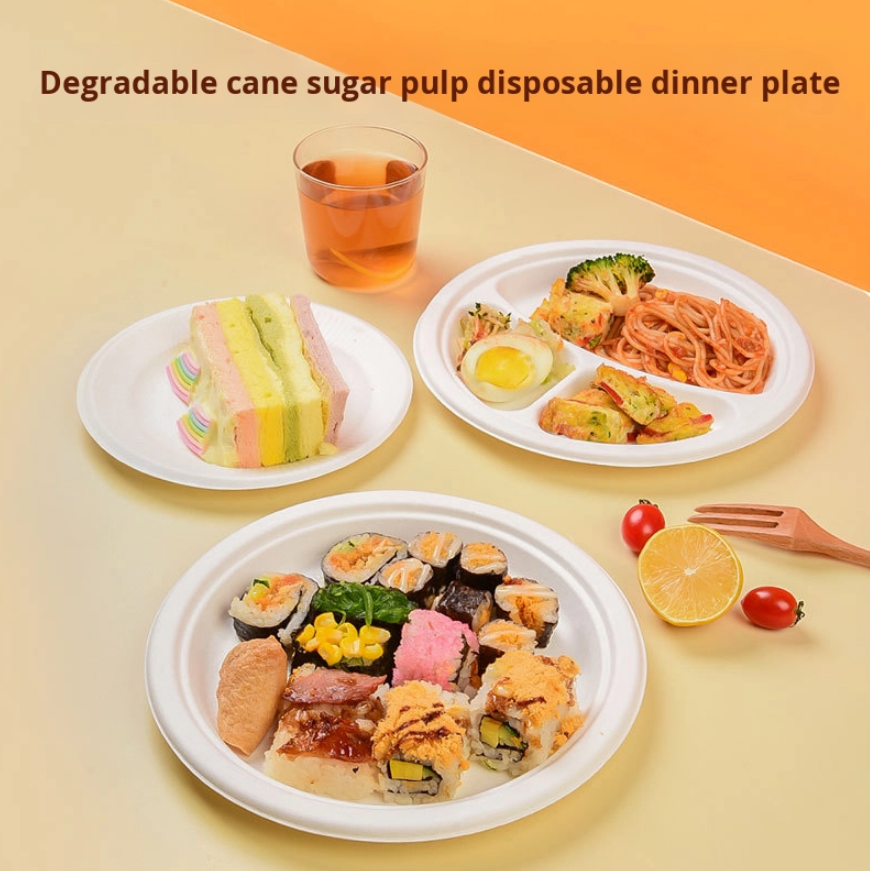
The packaging industry has invested heavily in molded fiber technology over the past decade. Rising demand for biodegradable food containers has encouraged manufacturers to improve production efficiency, product consistency, and material performance. Among the various renewable materials available today, bagasse food packaging continues attracting attention because it converts agricultural residue into functional food service products.
Bagasse originates from sugarcane processing. After sugar extraction, the remaining fibrous material is collected and dried before entering the pulp manufacturing stage. The fibers are cleaned and mixed with water to create slurry suitable for molding operations. Depending on the intended application, manufacturers may blend the pulp with bamboo fiber, wood pulp, or recycled paper to achieve specific mechanical properties.
The molding process generally involves vacuum forming combined with heat pressing. Fiber slurry is deposited onto precision molds where vacuum suction removes excess water. The semi-formed product is then transferred into heated molds for compression and drying. High-pressure thermoforming technology improves surface smoothness and structural consistency.
Production parameters vary according to product type. Typical molding temperatures range between 160°C and 220°C, while forming pressure may exceed 3 MPa during compression stages. Drying cycles are carefully controlled to achieve final moisture levels below 8% to 10%. Lower residual moisture helps improve shelf stability and reduce deformation risks during shipping.
Modern production lines emphasize automation. Robotic transfer systems, automated trimming machines, and computerized mold control systems improve production accuracy while reducing labor requirements. Large-scale factories may produce tens of thousands of containers per hour depending on equipment configuration.
Surface quality has improved significantly in recent years. Earlier molded fiber products often had rough textures and inconsistent edges. Advanced thermoforming now allows smoother finishes, cleaner edges, and tighter dimensional tolerances. This helps molded fiber containers compete more effectively with plastic packaging in retail and food delivery environments.
Barrier performance is another important research area. Food packaging must resist oil penetration and moisture absorption while maintaining compostability. Manufacturers increasingly use biodegradable coating systems or optimized fiber densities to improve grease resistance. PFAS-free solutions are also receiving greater attention as environmental regulations evolve.
Mechanical performance testing plays a major role in product development. Compression resistance, stacking strength, oil resistance, and thermal stability are evaluated before products enter commercial use. Some molded fiber trays can tolerate static loads above 1.5 kilograms without significant deformation.
Compostability remains a defining advantage. Under industrial composting conditions, sugarcane fiber packaging can degrade naturally within a relatively short period compared with conventional plastics. This characteristic supports waste reduction initiatives in restaurants, catering services, and institutional food operations.
Global interest in renewable packaging materials is also encouraging innovation in biodegradable material science. Researchers continue exploring antimicrobial coatings, nanocomposite reinforcement systems, and moisture barrier technologies for next-generation food packaging applications.
The molded fiber industry is no longer limited to simple disposable plates and trays. Today’s manufacturing systems can produce sophisticated multi-compartment containers, precision-fit lids, and custom embossed branding features. As sustainability standards continue tightening worldwide, technological improvements in sugarcane pulp packaging are expected to support wider adoption across the food packaging sector.
الأقسام
إقرأ المزيد
In 2026, Hornet's errands in Bellhart still carry the weight of small lives tangled together. The My Missing Brother quest in Hollow Knight: Silksong is one of those quiet stories that begins with a favor and ends with a rescue. Hornet does not simply stumble into it. She must first earn the trust of a courier family, then follow a trail that tests her memory of Greymoor's vertical spaces and...

Semiconductor Insight Publishes New ADAS AI SoC Market Research Report Examining Market Forecasts, Automotive AI Integration, Key Applications, and Competitive Developments The automotive industry is increasingly integrating artificial intelligence and advanced semiconductor computing into vehicle safety and driver-assistance systems. As automakers expand capabilities such as lane-keeping...
Explorarea tendințelor de diversificare a jocurilor de noroc în online: cum noile tipuri de pariuri și experiențele de joc personalizate vor transforma peisajul cazinourilor online în 2026 Industria jocurilor de noroc online https://nvcazinou.ro este într-o continuă expansiune și diversificare, adaptându-se rapid la cerințele și dorințele utilizatorilor care devin din ce...

Carbide Rotary Burs should be evaluated according to the actual machining task, equipment, and workpiece rather than product appearance alone. Buyers need to review head geometry, tooth arrangement, dimensions, shank size, working length, material compatibility, operating conditions, and manufacturing consistency. For distributors, workshops, and industrial purchasing teams, a detailed...

Examining the global Multi-Tasking Machine Tools market, covering comprehensive solutions for integrated manufacturing and multi-function machining, key technologies including CNC machines, turret machines, and milling centers, and the future outlook for multi-function CNC equipment through 2035. The Global Multi-Tasking Machine Tools Market represents the comprehensive landscape of integrated...