Coffee Substitute Market Forecast: USD 21.1 Billion by 2036 at 3.8% CAGR
NEWARK, Del., November 24, 2026 — The global coffee substitute market is witnessing steady growth as consumers increasingly explore alternatives to conventional coffee due to caffeine reduction preferences, changing beverage habits and rising coffee prices. Growing interest in roasted chicory, dandelion root, grain-based beverages and plant-based coffee alternatives is encouraging manufacturers to expand product portfolios and introduce convenient beverage formats. Increasing demand for caffeine-free drinks, functional botanical ingredients and easy-to-prepare instant beverages is further supporting market development across international markets.
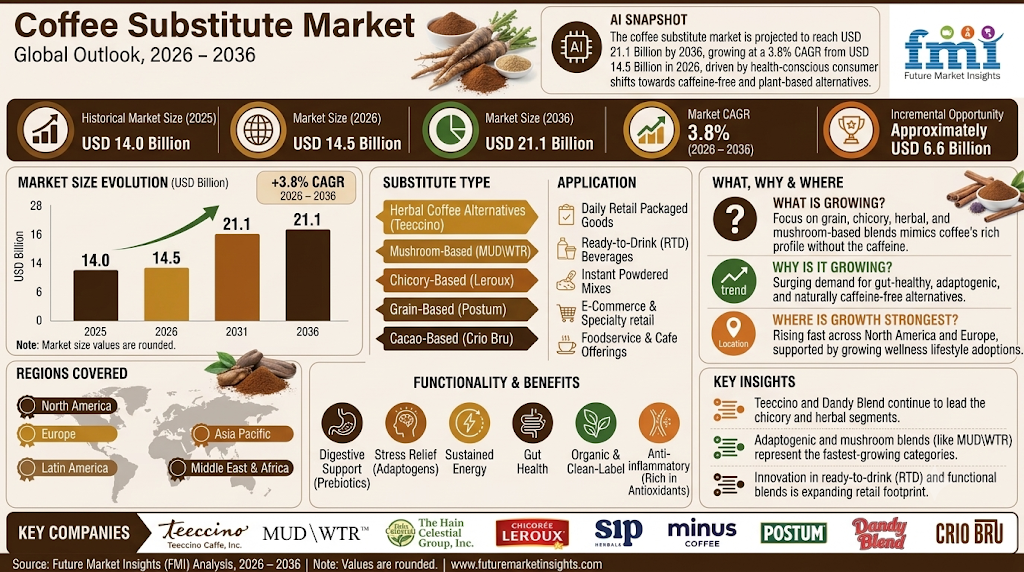
According to the latest market intelligence report published by Future Market Insights (FMI), the global coffee substitute market is estimated at USD 14.5 billion in 2026, increasing from USD 14.0 billion in 2025, and is projected to reach USD 21.1 billion by 2036, registering a compound annual growth rate (CAGR) of 3.8% during the forecast period. The market is expected to create an incremental opportunity of approximately USD 6.6 billion between 2026 and 2036.
The expansion reflects growing consumer interest in reducing caffeine consumption, increasing adoption of roasted herbal beverages and expanding retail availability of coffee alternatives. Manufacturers are also focusing on instant powders, single-serve brewer pods, Nespresso-compatible capsules and ready-to-mix botanical beverages to improve convenience and strengthen consumer adoption.
Get Detailed Market Forecasts, Competitive Benchmarking & Industry Insights: Request a Sample Report https://www.futuremarketinsights.com/reports/sample/rep-gb-36243
Market Size & Growth Forecasts
The coffee substitute market is projected to expand steadily through 2036 as demand for caffeine-free, herbal and grain-based beverage alternatives supports industry revenues.
- Market Size (2026): USD 14.5 Billion
- Forecast Value (2036): USD 21.1 Billion
- CAGR (2026–2036): 3.8%
- Incremental Opportunity: Approximately USD 6.6 Billion
- Historical Market Size (2025): USD 14.0 Billion
- Leading Product Segment: Herbal Coffee Substitutes
- Leading Form Segment: Powder
- Leading Distribution Channel: Supermarkets & Hypermarkets
- Largest National Market: United States
FMI's report identifies herbal coffee substitutes as the leading product category, supported by increasing consumer preference for roasted chicory and dandelion beverages. Powder-based products maintain a leading position because of their convenience, storage advantages and versatility. Supermarkets and hypermarkets remain important distribution channels as coffee alternatives gain visibility across mainstream grocery and specialty beverage aisles.
Key Market Takeaways
- Market Valuation: The coffee substitute market is estimated at USD 14.5 billion in 2026.
- Future Opportunity: The market is forecast to reach USD 21.1 billion by 2036.
- Growth Rate: The industry is projected to expand at a 3.8% CAGR from 2026 to 2036.
- Leading Product Segment: Herbal coffee substitutes account for approximately 49.0% of product segment revenue in 2026.
- Leading Form Segment: Powder products represent approximately 63.0% of form segment revenue.
- Leading Distribution Channel: Supermarkets and hypermarkets account for approximately 42.0% of distribution channel revenue.
- Largest National Market: The United States represents approximately USD 3.63 billion in market value in 2026.
- Fastest-Growing Country: Canada is projected to record a 4.2% CAGR through 2036.
- Other Important Markets: Germany and France are estimated at USD 1.74 billion and USD 1.45 billion, respectively, in 2026.
What Is Driving Growth in the Coffee Substitute Market?
- Rising Demand for Caffeine-Free and Low-Caffeine Beverages
Consumers are increasingly exploring alternatives to conventional coffee to manage daily caffeine intake and reduce the effects of stimulant consumption. Roasted chicory, dandelion root and grain-based beverages are gaining attention as options that provide familiar roasted flavors without relying on conventional coffee beans. These alternatives are particularly relevant for consumers seeking evening beverages and options for reducing their daily coffee consumption.
- Increasing Coffee Prices and Demand for Affordable Alternatives
Rising conventional coffee prices are encouraging households to evaluate alternative hot beverages based on cost per serving. Roasted grain and botanical products offer manufacturers opportunities to develop competitively priced alternatives for everyday consumption. Price-sensitive shoppers are increasingly considering instant chicory powders, roasted barley beverages and herbal blends as additions to their household beverage choices.
- Innovation in Instant Powders and Convenient Beverage Formats
Manufacturers are introducing microground herbal powders, instant botanical extracts and single-serve beverage formats to simplify preparation. Instant products reduce the need for conventional brewing equipment and lengthy steeping processes. K-Cup-compatible pods, Nespresso-compatible capsules and instant latte formulations are helping coffee substitute brands reach consumers seeking convenient preparation.
- Growing Interest in Functional Botanical and Plant-Based Ingredients
Increasing interest in botanical ingredients, plant-based beverages and functional drink formulations is creating opportunities for coffee substitute manufacturers. Roasted chicory, dandelion, adaptogenic mushroom blends and other plant-derived ingredients are being incorporated into differentiated beverage products. Manufacturers are using these ingredients to strengthen product positioning and appeal to consumers seeking alternatives to traditional coffee.
Segment Analysis: Product, Form and Distribution Channel
By Product: Herbal Coffee Substitutes Maintain a Leading Position
Herbal coffee substitutes account for approximately 49.0% of the product segment in 2026. Their leading position reflects increasing consumer interest in roasted chicory, dandelion root and botanical beverages that provide coffee-like flavor profiles without conventional coffee.
Key product categories include:
- Herbal Coffee Substitutes
- Grain Based Coffee Substitutes
- Plant Based Coffee Substitutes
Herbal coffee substitutes include roasted chicory, dandelion and botanical formulations. These products are gaining attention among consumers seeking caffeine-free beverage options and alternatives for different daily consumption occasions.
Grain-based coffee substitutes use ingredients such as roasted barley and rye to create traditional roasted beverage profiles. Plant-based coffee substitutes provide additional opportunities through formulations incorporating botanical and other plant-derived ingredients.
By Form: Powder Products Lead Market Demand
Powder products represent approximately 63.0% of the form segment in 2026. Their leading position is supported by convenient storage, comparatively lightweight distribution and flexible preparation options.
The form segment includes:
- Powder
- Liquid
Powder-based coffee substitutes include soluble granules, microground instant products and filter-brew formulations. These formats are suitable for household preparation and single-serve applications.
Liquid products, including chicory concentrates and botanical extracts, offer alternative preparation formats for beverage manufacturers and consumers seeking convenient formulations.
By Distribution Channel: Supermarkets and Hypermarkets Maintain Market Leadership
Supermarkets and hypermarkets account for approximately 42.0% of the distribution channel segment in 2026. These retail outlets provide visibility for coffee alternatives alongside conventional coffee, tea and other specialty beverages.
Key distribution channels include:
- Supermarkets & Hypermarkets
- Convenience Stores
- Specialty Stores
- Online
Supermarkets and hypermarkets remain important for product discovery, comparison and routine household purchases. Specialty stores provide opportunities for premium botanical and wellness-oriented beverage brands, while online platforms support direct-to-consumer sales, subscriptions and access to differentiated coffee substitute products.
Regional Growth Outlook
North America and Western Europe represent the core revenue centers for the global coffee substitute market. Established consumption of roasted grain and chicory beverages, growing interest in caffeine management and increasing retail availability of botanical alternatives support regional demand.
The United States represents the largest national market, while Canada is projected to record the fastest growth among the major country markets covered in the report. European markets, particularly Germany, France, the United Kingdom and Italy, benefit from established traditions of consuming roasted grain and chicory-based beverages.
Country-Level Growth Forecasts (2026–2036)
United States: The United States represents the largest national market, with revenue estimated at USD 3.63 billion in 2026 and projected to reach USD 5.17 billion by 2036, reflecting a 3.6% CAGR. High at-home beverage consumption, increasing interest in botanical coffee alternatives and expanding availability of instant products support market development.
Germany: Germany's coffee substitute market is estimated at USD 1.74 billion in 2026 and is projected to reach USD 2.53 billion by 2036, registering a 3.8% CAGR. Established consumption of roasted barley and rye beverages, together with demand for organic and caffeine-free alternatives, supports the country's market position.
France: France is expected to expand from USD 1.45 billion in 2026 to USD 2.11 billion by 2036, growing at a 3.8% CAGR. Established chicory consumption, domestic production capabilities and demand for convenient soluble and capsule-based products support market development.
United Kingdom: The United Kingdom coffee substitute market is projected to increase from USD 1.16 billion in 2026 to USD 1.69 billion by 2036, advancing at a 3.8% CAGR. Increasing interest in caffeine management, transparent ingredient labeling and convenient roasted botanical beverages is supporting adoption.
Canada: Canada is projected to record the fastest growth among the profiled country markets, expanding from USD 0.87 billion in 2026 to USD 1.31 billion by 2036 at a 4.2% CAGR. Rising interest in caffeine alternatives, at-home beverage preparation and soluble chicory products is creating opportunities for manufacturers.
Italy: Italy's coffee substitute market is expected to grow from USD 0.87 billion in 2026 to USD 1.26 billion by 2036, registering a 3.8% CAGR. Established consumption of roasted barley and chicory beverages, together with increasing conventional coffee expenditure, supports demand for alternative products.
Mexico: Mexico is projected to expand from USD 0.58 billion in 2026 to USD 0.85 billion by 2036, registering a 3.9% CAGR. Familiarity with soluble hot beverage powders and expanding modern retail distribution are creating opportunities for instant chicory and grain-based coffee substitutes.
Key Companies in the Coffee Substitute Market
The competitive landscape includes established chicory and grain beverage producers, botanical coffee alternative brands and emerging beanless coffee innovators. Market participants compete through ingredient innovation, product convenience, retail expansion, differentiated formulations and single-serve packaging.
Key companies profiled include:
- Teeccino Caffe, Inc.
- Mud Wtr Inc.
- The Hain Celestial Group, Inc. (Lima)
- Chicorée Leroux
- Sip Herbals
- Minus Coffee
- Postum
- Dandy Blend
- Crio Bru
These companies participate across different product categories, including roasted chicory beverages, herbal coffee substitutes, grain-based alternatives, mushroom blends and instant botanical formulations. Their competitive strategies increasingly emphasize caffeine transparency, convenient preparation, product differentiation and expansion across retail and e-commerce channels.
Explore the Full Coffee Substitute Market Report https://www.futuremarketinsights.com/reports/coffee-substitute-market
Growth Opportunities and Industry Challenges
Opportunities
- Instant Product Innovation: Microground powders, soluble botanical extracts and instant beverage sticks create opportunities to improve preparation convenience.
- Single-Serve Packaging: K-Cup-compatible pods and Nespresso-compatible capsules can attract consumers seeking alternatives that fit existing coffee preparation routines.
- Botanical Ingredient Development: Roasted chicory, dandelion and adaptogenic mushroom formulations provide opportunities for differentiated product portfolios.
- Retail Distribution Expansion: Supermarkets, hypermarkets and specialty grocery outlets can improve consumer awareness and product accessibility.
- Plant-Based Beverage Innovation: Beanless lattes and botanical formulations combined with plant-based milk ingredients can address evolving beverage preferences.
- Emerging Market Penetration: Growing availability of instant beverage products and modern retail distribution can support expansion across additional markets.
Challenges
- Gluten Allergen Management: Grain-based products containing barley and rye require clear allergen declarations and appropriate labeling.
- Consumer Awareness: Some consumers remain unfamiliar with coffee substitute ingredients, preparation methods and flavor profiles.
- Conventional Coffee Competition: Established coffee consumption habits and strong brand loyalty can limit substitution.
- Product Differentiation: Manufacturers must establish clear distinctions between herbal, grain-based and plant-based alternatives.
- Ingredient Transparency: Clear disclosure of caffeine content, allergens and botanical ingredients is important for consumer confidence.
- Distribution and Retail Competition: Specialty brands face competition for shelf space, retail partnerships and consumer attention.
Recent Developments in the Coffee Substitute Market
- June 2025: Teeccino Caffe, Inc. commercialized its Instant Teeccino range, combining microground roasted herbs with dehydrated extracts to provide convenient instant preparation.
- January 2026: Chicorée Leroux introduced Nespresso-compatible chicory capsules and instant sticks, expanding its convenient coffee alternative portfolio.
- January 2026: Sip Herbals expanded its single-serve coffee substitute offerings through K-Cup-compatible products.
- October 2026: Teeccino Caffe, Inc. expanded its K-Cup pod offerings, strengthening its presence in convenient retail beverage formats.
- October 2026: The Hain Celestial Group continued to disclose developments concerning its proposed divestiture of European businesses, including the Lima Yannoh grain-coffee brand.
Related Food & Beverage Industry Reports
About Future Market Insights (FMI)
Future Market Insights (FMI) is a market research and consulting organization providing industry intelligence, market forecasts and strategic insights to businesses across global markets. FMI's research supports manufacturers, investors, suppliers and decision-makers in evaluating market opportunities, understanding competitive environments and developing informed business strategies.
Media Contact
Rahul Singh
AVP – Marketing and Growth Strategy
Future Market Insights (FMI)
Phone: +91 8600020075
Sales: sales@futuremarketinsights.com
Media: Rahul.singh@futuremarketinsights.com
Website: https://www.futuremarketinsights.com
الأقسام
إقرأ المزيد
Driving conditions that involve uneven terrain, gravel roads, construction zones, or unpaved surfaces significantly increase exposure of the vehicle’s underside. Mechanical assemblies such as the oil sump, differential housing, exhaust routing, and transmission casing remain highly vulnerable to sudden impact loads. A Car Underbody Protection Plate is often integrated into vehicles...

The Retail Sales Market exhibits diverse segmentation across retail format, product category, and distribution channel categories, each contributing uniquely to the industry's growth trajectory. According to comprehensive market analysis, hypermarkets and supermarkets represent the dominant format segment, while e-commerce is set to register the highest growth . Understanding these...
We're simply at the midseason truth of the 2025 NFL a result, we utilised our Tuesday Neighborhood Speculate towards let our people towards specific their concerns upon what consists of stood out toward them optimum relating to the NFL year as a result local marvel: What stands out above all round NFL time therefore considerably?In this article are some of your comments:SnB Conclusion the RunIt...

Dietary fiber is a cornerstone of health, yet many people struggle to meet daily recommendations. The innovation of Fiber-Enriched Coffee offers a clever solution, turning a beloved morning staple into a significant source of soluble prebiotic fiber. As per Market Research Future, fiber-enriched coffee is gaining traction among consumers looking for effortless ways to boost their...

Large Round Wood Coffee Table designs are becoming an interesting choice for homeowners who want their living spaces to feel comfortable, welcoming, and visually balanced. Furniture is no longer selected simply to fill an empty area. People are paying closer attention to shapes, textures, colors, and how individual pieces influence the atmosphere of a room. For those planning a living room...