Wireless Communication Modules Market to Reach USD 15,792.1 Million by 2034, Expanding at a CAGR of 11.6%

The global Wireless Communication Modules Market is witnessing growth as connected devices, industrial automation systems, telecommunications equipment, and automotive applications increasingly require reliable wireless connectivity. Wireless communication modules integrate radio hardware and supporting electronics into packages that enable devices to communicate through cellular, Wi-Fi, Bluetooth, Zigbee, and other wireless technologies.
According to Semiconductor Insight, the market is valued at USD 5,881.2 million in 2025 and is projected to reach USD 15,792.1 million by 2034, registering a CAGR of 11.6% during 2026–2034. Asia-Pacific accounts for an estimated 40% of market demand, supported by its electronics manufacturing base and growing deployment of connected devices.
Explore the complete Wireless Communication Modules Market analysis:
https://semiconductorinsight.com/report/wireless-communication-modules-market/
Market Overview
Wireless communication modules provide embedded devices with the hardware and supporting functionality required to transmit and receive information wirelessly. They are used in industrial sensor gateways, connected medical equipment, automotive electronics, networking devices, energy systems, and consumer electronics.
The market includes modules designed for different communication standards, data requirements, operating environments, and power constraints. Manufacturers and equipment developers select modules based on wireless range, power consumption, certification requirements, compatibility, and product lifecycle support.
Key Market Drivers
The growing deployment of Internet of Things devices is a major factor supporting market expansion. Connected sensors, meters, industrial controllers, and remote monitoring equipment require wireless communication capabilities to exchange operational data.
Industrial automation and smart infrastructure are also increasing demand for embedded wireless modules. Cellular and low-power wireless technologies allow equipment manufacturers to connect devices across different operating environments while reducing the need for dedicated communication hardware development.
The expansion of connected automotive systems, healthcare devices, and telecommunications equipment further supports demand for reliable and application-specific wireless connectivity solutions.
Market Challenges
Wireless communication modules face challenges associated with radio-frequency interference, certification requirements, power consumption, and integration complexity. Manufacturers must ensure that modules meet the regulatory and technical requirements of the markets in which their products are sold.
Product lifecycle management is another important consideration. Equipment manufacturers often require long-term component availability, firmware maintenance, and security support, making supplier reliability an important purchasing factor.
Market Opportunities
The expansion of cellular IoT, smart manufacturing, connected healthcare, and energy monitoring creates opportunities for module manufacturers. Demand for compact, low-power, and multiprotocol modules may also support wider adoption across embedded applications.
The integration of multiple wireless functions into a single module can simplify product development and reduce design complexity for equipment manufacturers.
Download the sample report for detailed market insights:
https://semiconductorinsight.com/download-sample-report/?product_id=82074
Market Segmentation
The Wireless Communication Modules Market is segmented across the following categories:
By Type
-
Wireless Data Transmission Modules
-
Wireless Transceiver Modules
-
ASK Superheterodyne Modules
By Application
-
Telecom/Datacom
-
Automotive
-
Industrial
-
Power and New Energy
-
Healthcare
-
Others
By Region
-
North America
-
Europe
-
Asia-Pacific
-
Latin America
-
Middle East & Africa
Wireless Data Transmission Modules represent the largest type category, with an estimated 60% share. Telecom/Datacom leads application demand at approximately 33%, followed by Industrial at 23% and Automotive at 18%.
Regional Market Outlook
Asia-Pacific represents the largest regional market, accounting for an estimated 40% of demand. The region benefits from electronics manufacturing capacity and the deployment of connected consumer, industrial, and communications equipment.
North America accounts for an estimated 28% of the market, supported by industrial connectivity, healthcare technology, and networking applications. Europe represents approximately 23%, with demand linked to automotive electronics, industrial machinery, and energy systems.
Latin America and the Middle East & Africa represent smaller but developing markets, with opportunities associated with remote monitoring, connected infrastructure, and industrial applications.
Competitive Landscape
The wireless communication modules market includes suppliers specializing in cellular connectivity, embedded wireless modules, radio-frequency technologies, and multiprotocol solutions.
Key companies profiled include Murata, ROHM, STMicroelectronics, TDK, NXP, Microchip Technology, Texas Instruments, Nordic Semiconductor, Espressif Systems, Quectel, Semtech, u-blox, Digi International, Ezurio, Telit Cinterion, and Renesas Electronics.
Competition is influenced by product reliability, wireless protocol support, module size, power efficiency, certification capabilities, firmware maintenance, and long-term supply availability.
What Does the Wireless Communication Modules Market Report Cover?
The report examines market size and forecasts, type and application segmentation, regional demand, technology developments, competitive positioning, and the factors influencing wireless module adoption. It also evaluates the role of industrial connectivity, cellular IoT, and embedded wireless technologies in shaping market development through 2034.
Key Questions Answered by the Study
-
What was the global Wireless Communication Modules Market size in 2025?
-
What market value is projected for 2034?
-
What is the expected CAGR during 2026–2034?
-
Which type category accounts for the largest market share?
-
Which applications generate the highest demand?
-
How is industrial IoT adoption influencing the market?
-
What role do cellular and low-power wireless technologies play?
-
What challenges affect module integration and certification?
-
Which region accounts for the largest market share?
-
Who are the key companies profiled in the report?
-
What opportunities are emerging in automotive and healthcare connectivity?
-
How are multiprotocol modules influencing product development?
Access the full report for in-depth insights:
https://semiconductorinsight.com/report/wireless-communication-modules-market/
Request the sample report:
https://semiconductorinsight.com/download-sample-report/?product_id=82074
About Semiconductor Insight
Semiconductor Insight provides market research and industry intelligence across the global semiconductor and electronics ecosystem. Its research coverage includes market sizing, technology trends, competitive analysis, regional developments, and strategic insights to support business decisions.
Contact Semiconductor Insight
Website: https://semiconductorinsight.com/
Categorias
Leia mais
В случае если необходима врачебная справка, имеется только 2 варианта на текущий день: все сделать как обычно: позвонить терапевту, ждать, отправиться в медицинскую поликлинику. А возможно поступить намного проще, отправившись в нашу компанию. Практически любые врачебные справки подписываем в течении получаса, их сможете собственноручно забрать или же заказать доставку курьером. Но следует...

After defeating the Widow in Deep Docks and claiming the Needolin, Hornet remembers a peculiar sealed door she passed at the very beginning of her journey through Moss Grotto. Something about it calls her back. When she returns and plays the Needolin, the door dissolves into strands of light, revealing Weavenest Atla—a hidden sanctuary that feels less like a boss arena and more like a...
The future of the Hydrogen Inhalation Unit Market is incredibly promising, characterized by rapid technological innovation, expanding applications, and a healthcare system that is increasingly embracing alternative and integrative therapies. As we look ahead to 2035, the market is projected to grow to $2.5 billion, driven by a combination of factors, including the rising prevalence of...
The Solar Thermal Collectors Market Size is experiencing significant growth, driven by rising energy costs, environmental regulations, and technological innovations. According to comprehensive market analysis, the market was valued at approximately USD 30.22 Billion in 2024 and is projected to reach USD 71.55 Billion by 2035, growing at a CAGR of 8.15% during the forecast period...

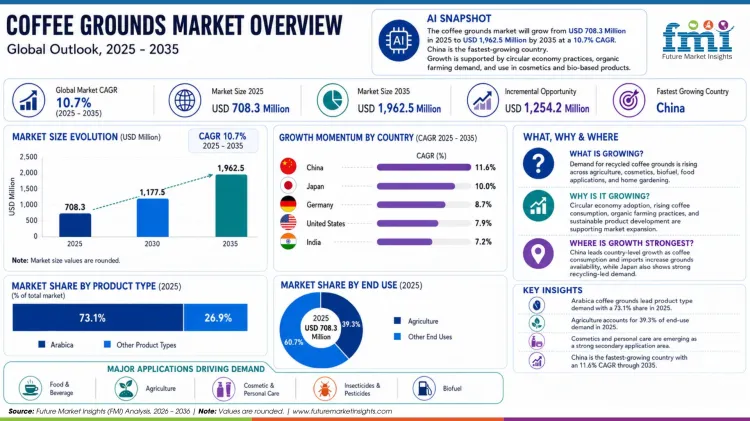
Coffee Grounds Market to Reach USD 1.96 Billion by 2035 at 10.7% CAGR NEWARK, Del., October 14, 2026 — The global Coffee Grounds Market is gaining momentum as businesses increasingly repurpose used coffee grounds for agriculture, cosmetics, biofuel, and other sustainable applications. According to the latest market report published by Future Market Insights (FMI), the market is...