


Distribution Transformer Market Share Shifts to Air-Cooled
Market share analysis in the distribution transformer sector reveals a competitive landscape where established oil-cooled leaders retain dominance while air-cooled configurations and residential end uses reshape positioning. Based on Market Research Future's assessment, the Distribution Transformer Market Share is distributed across a market valued at USD 42.59 billion in 2025 and projected to reach USD 95.85 billion by 2035 at an 8.45% compound annual growth rate. Tracking where share sits today, and where it is migrating, provides a clearer picture of competitive dynamics than aggregate growth figures alone.
Share Distribution Across Power Ratings and Cooling Types
Small-rated distribution transformers below 10 MVA dominate at 62.1% revenue share in 2025 because they serve the largest installed base — residential neighborhoods, commercial buildings, and distributed solar installations. Utilities procure these units in high volumes under framework contracts, making manufacturing efficiency and logistics critical competitive factors. Medium-rated units between 10 MVA and 100 MVA represent the fastest-expanding power bracket at 9.2% CAGR as solar parks, wind farms, and industrial campuses demand higher-capacity step-down transformation closer to generation points. The large-unit segment above 100 MVA serves niche but high-value applications at USD 3.41 billion in 2025.
Oil-cooled designs continue to anchor the market at 68.5% share due to established cost structure and proven thermal performance across a wide ratings spectrum. Air-cooled transformers, while carrying a price premium, are gaining share at a 9.5% CAGR in urban, indoor, and environmentally sensitive installations where fire codes or contamination risks preclude liquid-filled equipment. The shift toward ester-based insulating fluids is blurring this traditional boundary, as ester-filled units offer fire-safety benefits approaching dry-type performance while retaining the thermal efficiency advantages of liquid immersion.
Share Dynamics Across Phases and End Users
Three-phase configurations dominate utility and industrial procurement at 76.2% volume share, as they deliver balanced power for motor loads and large commercial facilities. Single-phase units, prevalent in North American residential networks and rural electrification programs in South Asia and Africa, are growing faster at 9.4% CAGR from a smaller base as governments prioritize last-mile connectivity and household-level energy access.
Power utilities remain the anchor buyer at 52.1% share, procuring units for grid expansion, voltage regulation, and fleet replacement. Residential end-use is the fastest-growing segment at 9.7% CAGR as housing construction in emerging markets and EV home-charging adoption in developed markets drive transformer installations at the neighborhood level. Industrial grows at 8.7% CAGR on manufacturing, mining, and process industries. Commercial represents USD 6.39 billion in 2025 for buildings, data centers, and retail.
Regional Share Concentration
Asia-Pacific captured a 45.5% share in 2025, anchored by large multiyear utility tenders, with China at 38.2% of regional share, India growing at 9.3% CAGR, Japan at USD 2.87 billion, South Korea growing at 7.9% CAGR, ASEAN growing at 8.8% CAGR, and Rest of Asia-Pacific at USD 1.52 billion. Europe holds 22.0% share, with Germany growing at 8.6% CAGR, the UK at 7.8% CAGR, France at USD 2.14 billion, Italy at 7.5% CAGR, Spain at USD 1.28 billion, Nordic Countries at 8.1% CAGR, Russia at USD 0.96 billion, and Rest of Europe at 7.4% CAGR. North America contributes 18.5% of global revenue, with the U.S. at 72.4% of regional share, Canada at 15.8%, and Mexico at 11.8%. South America and the Middle East and Africa each hold 7.0% share.
Competitive Forces Reshaping Share
The market exhibits moderate concentration, with the top five players accounting for an estimated 35–42% of global revenue and barriers to entry remaining significant due to capital intensity of winding equipment, long qualification cycles with utility buyers, and supply-chain access for grain-oriented electrical steel and insulation paper.
Hitachi Energy holds approximately 8–11% through oil-immersed, dry-type, ester-filled, and digital monitoring offerings, positioned as global full-portfolio leader with smart-grid integration. Siemens Energy holds approximately 7–10% through GEAFOL dry-type, oil-immersed, and green transformers, positioned as European technology leader and eco-design pioneer. Schneider Electric holds approximately 5–8% through medium-voltage, pad-mounted, and oil-immersed units, with a solutions-integrated approach and strength in the commercial segment. Eaton Corporation holds approximately 4–7% through pad-mounted, submersible, and specialty liquid-filled units, as North American distribution-utility specialist. GE Vernova holds approximately 4–6% through the Prolec GE range, oil-immersed, and amorphous-core units.
Recent developments include Siemens Energy launching the Green Transformer initiative in June 2024. The U.S. Department of Energy finalised updated energy-conservation standards in April 2024, effective January 2027. TBEA Co. won a State Grid Corporation framework contract valued at over USD 500 million in November 2023. CG Power signed a technology licensing agreement with Hitachi Energy in August 2023 to manufacture amorphous-core distribution transformers at its Nashik facility. Schneider Electric acquired a controlling stake in a Malaysian dry-type transformer manufacturer in May 2023.
Challenges Affecting Share Stability
Share positions are not fixed. Volatile copper and GOES prices reduce growth potential by 0.6 to 0.9 percentage points, with GOES and copper combined making up 40–50% of the bill of materials. Skilled-labor shortages reduce growth by 0.5 to 0.8 points, with capacity expansion plans constrained less by capital than by the time required to recruit, train, and certify production staff. Lead-time elongation reduces growth by 0.4 to 0.7 points, forcing utilities to front-load purchasing and accept standardized designs rather than custom specifications, potentially compressing pricing power.
Future Outlook for Share Distribution
The forward view anticipates share migration rather than wholesale displacement. Oil-cooled designs are expected to retain leadership, while air-cooled gains share. Residential is expected to gain share relative to utilities in percentage terms. Ester-fluid platforms are expected to gain share within liquid-filled designs. Amorphous-core designs are expected to gain share in loss-sensitive grids as regulatory incentives reward low-loss equipment through performance-based rate structures.
Expert Discussion
Analysts note that share leadership in distribution transformers is less about any single configuration than about fit between transformer characteristics and installation requirements. Small units suit high-volume residential and commercial deployment; medium units suit renewable interconnection and industrial campuses; oil-cooled designs suit cost-sensitive rural and industrial applications; air-cooled designs suit fire-sensitive urban and indoor installations; three-phase units suit industrial and commercial feeder loads; single-phase units suit rural last-mile connectivity.
Experts also emphasize that embedding IoT sensors for dissolved-gas analysis, thermal imaging, and load profiling transforms the transformer from a passive asset into a data-generating node, with utilities piloting digital-twin platforms reporting 15–20% reductions in unplanned outage costs, creating a recurring-revenue opportunity for OEMs willing to bundle monitoring subscriptions alongside hardware sales.
Conclusion
The distribution transformer market share landscape reflects a sector where leadership is distributed across power ratings, cooling types, and regions. Current share positions favor small units in power rating and oil-cooled in cooling type, while air-cooled and residential represent the fastest-moving share gainers. Emerging opportunities lie in ester-fluid platforms, smart monitoring, and amorphous-core adoption. Technological developments in advanced materials and grid-edge digitization are steadily reshaping competitive positioning. The long-term outlook anticipates continued share migration toward integrated, digitally enabled providers, with the Distribution Transformer Market evolving into a more technology-segmented competitive arena by 2035.
Categorii
Citeste mai mult
The Medical Microcontrollers market is experiencing a transformative phase, forecasting substantial growth driven by a myriad of industry trends. By 2035, the market is expected to reach a staggering $116.11 billion, propelled by an impressive compound annual growth rate (CAGR) of 11.5%. This upward trajectory points to significant advancements in medical technology and an increased focus on...

Electric Fan Injection Mould plays an important role in creating consistent parts for household and commercial products. Buyers looking for suitable tooling solutions need to review several aspects before beginning cooperation. Material selection, design planning, processing ability, and supplier communication can all influence the final result. A careful evaluation helps companies reduce...

In building installation and structural work, drilling into dense materials requires tools designed for impact strength and secure connection. Many operators select Fangda SDS Plus Hammer Drill products from fangda-tools when working on concrete, brick, and reinforced surfaces. The SDS Plus system is known for its quick locking mechanism and stable power transfer, allowing the drill to maintain...

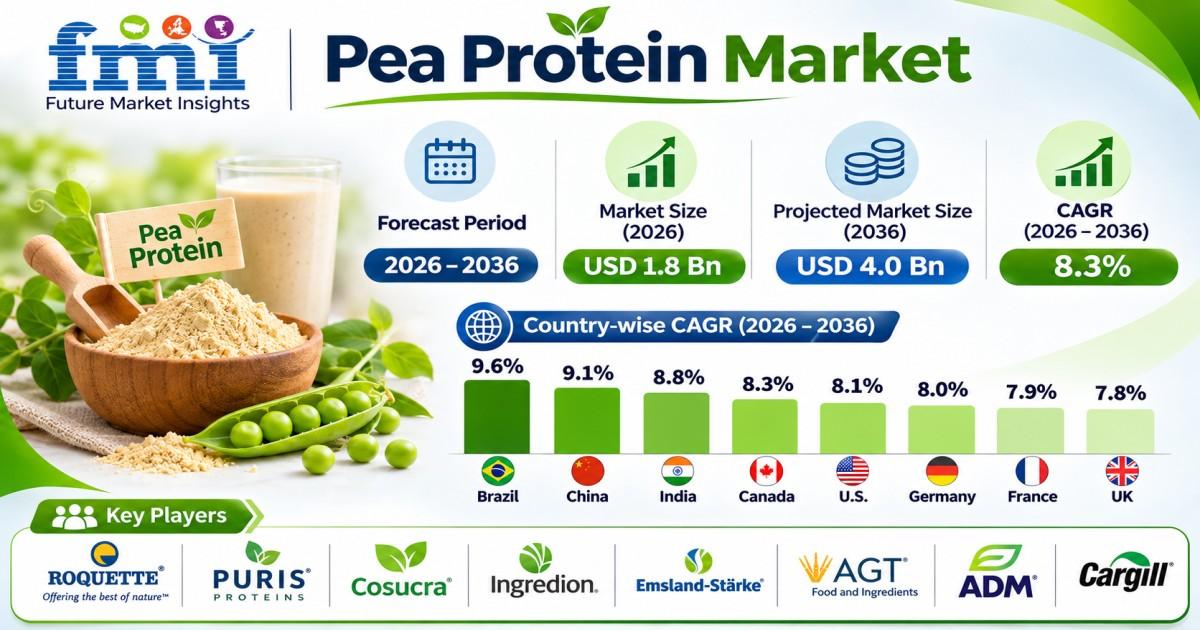
Market Research Report: Pea Protein MarketForecast Period: 2026–2036Market Size (2026): USD 1.8 billionProjected Market Size (2036): USD 4.0 billionCAGR (2026–2036): 8.3% Request full Report Pricing and Sample Report: https://www.futuremarketinsights.com/reports/sample/rep-gb-697 Global Pea Protein Market Forecast Signals New Opportunities for Plant-Based...
Examining the global Helium Compressor market, covering comprehensive solutions for high-purity gas compression, key technologies including reciprocating, screw, scroll, and centrifugal compressors, and the future outlook for industrial helium compression systems through 2035. The Global Helium Compressor Market represents the comprehensive landscape of high-purity gas compression and helium...
