Thermoelectric Generator Market to Hit $3.02B by 2035

The Thermoelectric Generator Market was valued at USD 1.11 billion in 2025, opens the forecast window at USD 1.23 billion in 2026, and is projected to reach USD 3.02 billion by 2035 at a 10.5% compound annual growth rate. Two catalysts anchor that trajectory: the U.S. Environmental Protection Agency's 2024 greenhouse-gas standards for light- and medium-duty vehicles created a technology-neutral compliance pathway rewarding solid-state heat-to-power conversion, and the Department of Energy has committed more than USD 104 million through its Industrial Efficiency and Decarbonization Office to recover process heat that industry currently vents to atmosphere.
Report Key Statistics
Replacement economics are doing the rest: organic Rankine cycle skids, thermophotovoltaic prototypes, and diesel gensets are giving way to modules with no moving parts, no working fluid, and service intervals measured in decades. Nano-structured bismuth-telluride and silicon-germanium alloys have pushed laboratory conversion efficiency toward 15%, cutting payback periods on industrial installations from roughly nine years to under six.
Type segmentation shows single-stage modules commanding a 51.2% revenue share in 2025, the default architecture wherever temperature differentials stay below 250°C. Multi-stage and cascaded systems are the fastest-expanding architecture at a 13.2% CAGR through 2035.
Application segmentation shows automotive generating USD 0.40 billion in 2025 as the single largest revenue pool, industrial holding 22.4% share, aerospace and defense holding 17.9% application share insulated from price competition by qualification barriers, and consumer electronics and wearables growing fastest among applications at a 14.6% CAGR.
Material segmentation shows bismuth telluride holding 58.8% share on mature supply chain and near-ambient performance, lead telluride at USD 0.21 billion, and silicon-germanium the fastest-growing at 14.2% CAGR on high-temperature and space applications. Source-of-heat segmentation shows waste heat recovery at 58.1% share, direct heat source at USD 0.33 billion, and body heat the fastest-expanding at 15.8% CAGR.
Industry Trends
Emission regulation as a procurement trigger is the first trend. The EPA's finalized standards require a fleet-average CO₂ reduction of roughly 50% for light-duty vehicles by model year 2032 against 2026 levels, and because the rule is technology-neutral, exhaust heat recovery counts toward compliance credit without forcing a powertrain redesign. A recovery unit harvesting 600–800 W from a tailpipe stream translates to a 2–4% fuel-economy improvement.
Industrial heat recovery funding is the second trend. Roughly 20–50% of energy consumed by U.S. manufacturing exits as waste heat, and grant structures typically cover 30–50% of installed cost, compressing payback below the five-year threshold most plant managers require. Material efficiency breakthroughs form the third trend: nano-structuring and hierarchical grain engineering lifted demonstrated device efficiency from roughly 8% toward 15% in high-differential configurations, with cost decline at roughly 6% annually since 2021.
Challenges
The efficiency ceiling limits adoption: organic Rankine cycle systems can convert 10–20% of recovered heat at flow rates for which rotating equipment is justified, and at large scale solid-state technologies are still less efficient. Raw material concentration constrains supply: tellurium is recovered mostly as a byproduct of copper refining, and spot prices fluctuated by more than 40% from 2022 to 2024. Cost per watt sits near USD 3.00–6.00 for industrial systems against USD 0.90–1.40 for grid-tied photovoltaics.
Future Outlook
Data-center low-grade heat represents a significant opportunity: global data center electricity usage could reach 945 TWh by 2030, and liquid-cooled AI racks now reject heat in concentrated, continuous streams at 45–60°C that fit low-differential modules. Emerging-market off-grid deployment is growing, with sub-Saharan Africa and Andean South America hosting thousands of communication towers and pipeline monitoring posts powered by diesel. Energy-as-a-service business models are shifting vendors from equipment sales to guaranteed-savings contracts. Space nuclear power procurement and building-integrated micro-harvesting complete the opportunity set.
Expert Discussion
Competitive concentration is moderate, with estimated HHI near 1,050 and the top five suppliers holding a combined 41–48% of revenue. Gentherm holds approximately 11–14% revenue share through automotive thermal and heat-recovery systems, positioned as OEM-embedded and compliance-led. Coherent Corp. holds approximately 9–12% through high-reliability modules for defense and space, vertically integrated on material control. Ferrotec Holdings holds approximately 8–11% through volume module manufacturing, positioned as scale manufacturer and cost leader. KELK Ltd. holds approximately 6–9% through industrial waste-heat generation units. Yamaha Corporation holds approximately 5–7% through compact modules for consumer integration. Laird Thermal Systems holds approximately 4–6% through medical and instrumentation thermal solutions.
Recent developments include Gentherm expanding its automotive thermal engineering footprint in September 2024 to support OEM programs restarting exhaust recovery development ahead of 2027 compliance deadlines, Coherent Corp. extending high-reliability module qualification for space and defense platforms in January 2025, and Ferrotec commissioning additional module manufacturing capacity in Asia in June 2024.
Conclusion
The sector shows strong growth fundamentals. Current momentum rests on single-stage architecture dominance and automotive application leadership. Emerging opportunities lie in data-center heat recovery, off-grid deployment, and energy-as-a-service models. Technological developments in half-Heusler and skutterudite chemistries are steadily improving efficiency and supply stability. The long-term outlook anticipates the Thermoelectric Generator Market reaching USD 3.02 billion by 2035, supported by emission regulation, industrial decarbonization funding, and material innovation worldwide.
Categorías
Read More
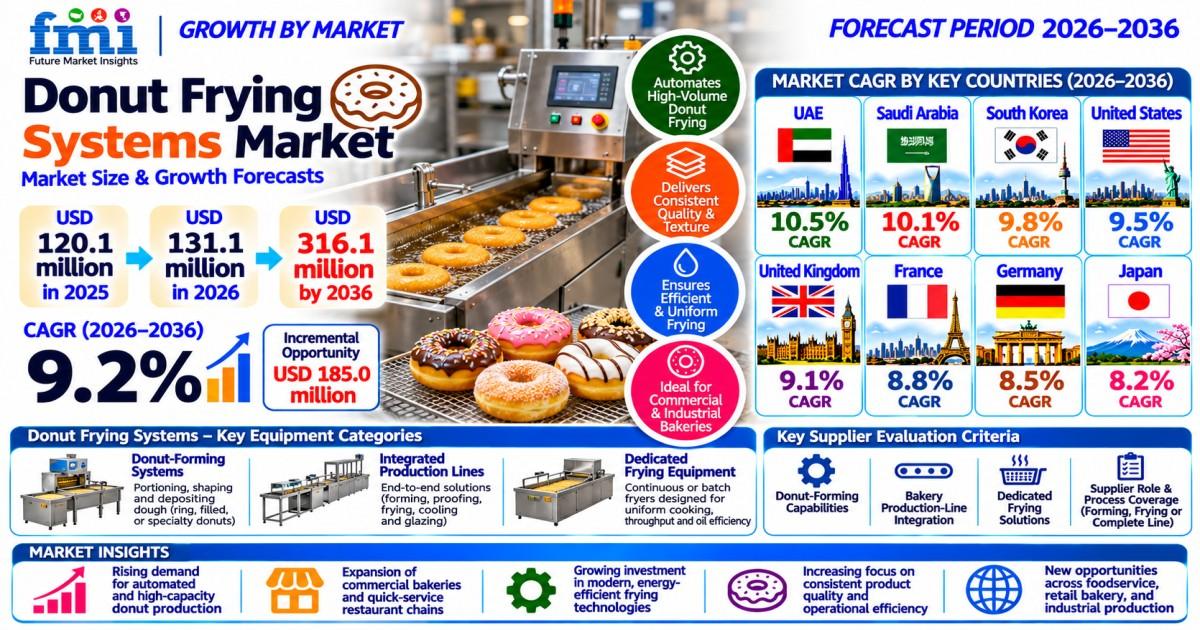
The global donut frying systems market is estimated at USD 131.1 million in 2026, up from USD 120.1 million in 2025, and is projected to expand to USD 316.1 million by 2036. According to new research published by Future Market Insights, Inc., the industry is forecast to grow at a compound annual growth rate (CAGR) of 9.2% over the ten-year assessment period, generating USD 185.0 million in...
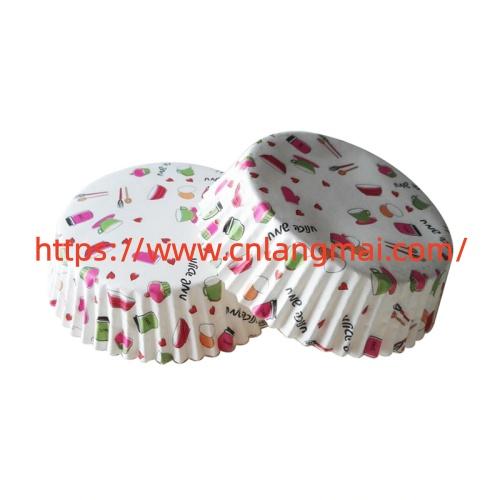
PET Film Cupcake Liners can give baked products a neat presentation while helping staff handle individual portions with greater convenience. For bakeries, cafes, dessert shops, catering businesses, and food packaging buyers, the right format can influence how products appear at the point of sale and how easily they can be moved during preparation, display, and service. Material selection,...
North America represents a significant growth region for range cookers due to increasing investments in modern kitchen remodeling projects and the growing popularity of premium home appliances. Consumers are seeking multifunctional cooking solutions that combine efficiency, design, and advanced technology. Demand is further supported by higher disposable incomes, smart home adoption, and...

Temperature monitoring plays an important role in healthcare because even small temperature variations can affect patient safety, clinical decisions, and the quality of temperature-sensitive medical products. Blood temperature indicators and related monitoring technologies support healthcare professionals in observing temperature conditions during clinical procedures, laboratory operations, and...
Underwear Accessories can play a useful role in organizing laundry routines and helping people care for delicate garments. Items made with lace, fine mesh, elastic fibers, or decorative details may require gentler handling than everyday clothing. Choosing suitable washing methods, checking care labels, and using appropriate laundry accessories can help reduce stretching, snagging, and...