Precision Injection Molding Industry: Micron Tolerances and Medical Demand Drive Growth

The global Precision Injection Molding Industry is defined by steady, application-driven expansion rather than speculative hype. While the specific URL you provided returned a 404 error, available market research indicates the segment is benefiting from structural demand for miniaturized components across medical, electronics, and automotive applications. Global Market Insights values the global micro injection molded plastic market at USD 1.4 billion in 2024, projected to reach USD 3.9 billion by 2034 at an 11% CAGR . This trajectory reflects the essential role precision injection molding plays in enabling components with tolerances measured in microns—parts that conventional molding cannot reliably produce. Understanding the forces behind this growth requires examining segment dynamics, regional leadership, technological enablers, and the persistent barriers that shape adoption patterns.
Market Size and the Economics of Precision Manufacturing
The market data from available research indicates consistent growth. The micro injection molded plastic segment was valued at USD 1.4 billion in 2024, with projections reaching USD 3.9 billion by 2034 . The broader micro injection molded products market, which includes finished components rather than just materials, shows even larger scale: USD 9.9 billion in 2025, reaching USD 20.91 billion by 2032 at 11.4% CAGR .
The medical segment represents the most valuable application. According to QYResearch, the global micro-injection molded medical plastics market recorded approximately USD 538 million in sales in 2025, projected to reach USD 1.191 billion by 2032 at a 12.2% CAGR . Healthcare and diagnostics accounted for 46.68% of 2025 demand in the broader micro injection molded plastic market, anchored by pre-filled syringes, insulin pens, and microneedle patches .
Application Segments: Medical Dominates, Electronics Accelerate
By application, medical and healthcare represents the largest and most valuable segment. Demand is driven by minimally invasive surgical instruments, drug delivery systems, diagnostic devices, and implantable components . The aging global population and advances in medical technology continue to push demand for these precision parts. ARBURG, a leading injection molding machine manufacturer, has demonstrated production of pre-filled syringes using COP glass substitute materials and micro-switch protective covers weighing just 0.009 grams with a cycle time of only 20 seconds .
Electronics and semiconductors represent the fastest-growing segment, projected to grow at a 12.68% CAGR through 2031 as flexible sensors in wearable devices accelerate adoption of LCP and COC parts below 0.1 grams . Automotive applications follow the overall market growth rate, with a shift from polycarbonate to LCP for radar domes sustaining value over volume .
Regional Dynamics: Asia-Pacific Leads, North America Follows
Asia-Pacific held 41.12% of 2025 revenue and is forecast to expand at a 12.51% CAGR through 2031 as China's precision mold industry advances toward CNY 1 trillion in production by 2030 . Japanese toolmakers achieve ±0.01 mm capability, commanding 15–20% premiums essential for implants, while South Korea's semiconductor packaging drives local LCP consumption . ASEAN nations attracted USD 31 billion in electronics FDI in 2024, positioning Vietnam and Malaysia as overflow hubs within China-plus-one strategies .
North America and Europe trail Asia-Pacific growth by 3–4 percentage points. The United States hosts eight of the fifteen largest micro-molders, including Tessy Plastics with USD 460 million in 2025 sales, but a shortage of ultra-precision toolmakers has pushed new mold lead times beyond 22 weeks . Germany's Baden-Württemberg and Bavaria clusters leverage Fraunhofer IPT metrology to maintain scrap rates at 0.15% and economically viable 5,000-piece batches .
Technological Enablers: All-Electric Machines, LSR, and AI Metrology
Technological advancements are reshaping precision injection molding. ARBURG's all-electric injection molding machines feature servo-electric drives and high-quality injection units, achieving micron-level tolerances and producing burr-free, highly consistent micro-seals . The company's patented LSR technology uses zero-compression-ratio, low-L/D screws and patented silicone components to prevent leakage and flash, achieving injection precision of 0.01 mm .
Energy efficiency is a growing focus. ARBURG's electric machines feature servo-electric toggle clamping units and braking energy recovery systems, reducing energy demand by up to 50% compared to standard hydraulic presses . Its NextGen Medical Solution digital production cell cuts overall energy consumption by about 50% and reduces floor space by 25% .
Material innovation is also shaping the industry. TOPOLEFIN TECHNOLOGY's self-developed TAMT cyclic olefin copolymer (COC) is China's first mass-produced COC material to obtain FDA DMF filing and ISO 10993 and USP Class VI certifications, ending long-standing import dependence . AI-enabled inline metrology platforms like Fraunhofer IPT's SURFinloop adjust molding parameters in real time, reducing average scrap to 0.15% .
Challenges: Tooling Lead Times, Material Validation, and Skills Gap
The precision injection molding industry faces structural challenges. Tooling represents a practical capacity constraint. Sub-millimeter cavities require specialized machining, metrology, and process-debugging expertise, and the shortage of ultra-precision toolmakers has pushed new mold lead times beyond 22 weeks in the United States .
Material re-validation raises the cost of supplier changes. The EU Medical Device Regulation's traceability rules, fully applied in 2024, add 8–12 weeks to first device registrations, favoring incumbents with ISO 13485 track records . High initial tooling costs remain a barrier for new entrants and smaller programs .
The skills gap adds another layer of risk. Precision injection molding requires expertise in polymer science, mold design, process optimization, and metrology. The shortage of trained technicians can delay deployment, increase costs, and compromise quality.
Competitive Landscape and Strategic Developments
The market is moderately consolidated, with leaders operating Class 7/8 cleanrooms and maintaining fleets of 40 or more micro presses with ±0.5 µm metrology . Tessy Plastics illustrates this model, operating 400 presses across 3.2 million square feet and maintaining tolerances of 0.0005 inches . MTD Micro Molding doubled its floor space in 2024 to meet demand for automotive radar domes and medical devices requiring ±0.02 mm repeatability . Accumold presented cannula molding with 0.004-inch walls at MD&M West, achieving 40 million parts annually in ISO 13485 suites .
Equipment manufacturers continue to invest in capacity. Sodick announced plans to expand production of ultra-precision injection molding machines for optical communication connectors, targeting 3x capacity by 2028 compared to 2026, driven by AI data center demand .
Future Outlook: Precision Demands Accelerate
The precision injection molding industry is projected for sustained growth, driven by miniaturization trends, medical device innovation, and automotive electrification. Three factors will shape the long-term trajectory. First, the shift toward smaller, more complex components in medical devices and electronics will sustain demand for precision molding capabilities. Second, material innovation—including high-performance polymers like PEEK and LCP, and domestic COC alternatives—will expand application possibilities. Third, automation, AI process control, and inline metrology will improve yields and reduce costs, enabling broader adoption.
Conclusion
The Precision Injection Molding Industry stands at an inflection point. The sector has moved beyond conventional molding into a phase of sustained expansion, with medical applications providing a stable base and electronics and automotive offering growth upside. Asia-Pacific's manufacturing scale and North America's innovation leadership create a geographically balanced growth profile. Technological advancements in all-electric machines, LSR technology, and AI metrology are lowering adoption barriers while enabling new applications. The challenges—tooling lead times, material validation, and skills gap—are real but manageable for vendors that invest in equipment, process expertise, and customer collaboration. The path forward will reward suppliers who can deliver consistent micron-level precision at scale, support the documentation requirements of regulated industries, and integrate automation without compromising quality.
Categorie
Leggi tutto
High-purity products are becoming increasingly significant in the US Hydrofluoric Acid Market, particularly because of the expansion of semiconductor and electronics manufacturing. Market Research Future identifies high-purity hydrofluoric acid as the largest purity segment in its US market analysis. Semiconductor fabrication requires extremely controlled chemical environments. Even small...

A influência dos jogos de azar mobile na geração Z em 2026: como as preferências e comportamentos de apostas dessa nova geração estão moldando o futuro dos cassinos online No decorrer da última década, a indústria de jogos de azar experimentou uma transformação significativa, impulsionada principalmente pelo...

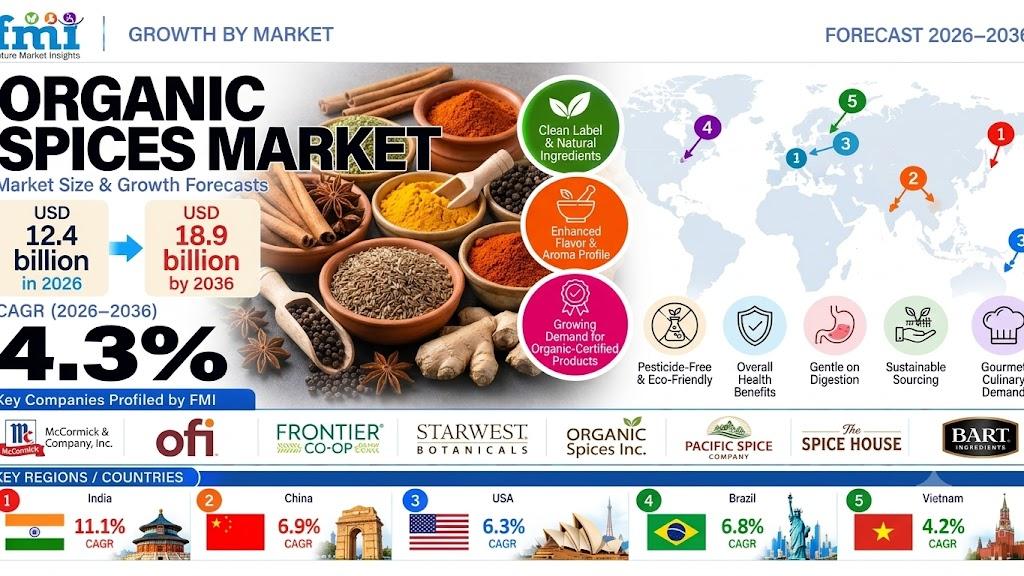
Organic Spices Market to Reach USD 18.9 Billion by 2036 NEWARK, Del., October 21, 2026 — The global Organic Spices Market is gaining momentum as consumers, food manufacturers, and foodservice operators increasingly seek certified organic ingredients that support clean-label positioning, product quality, and transparent sourcing. According to the latest market intelligence report published...
Examining the commercial beer tap system market, covering advanced solutions for craft beer and hospitality applications, key technologies including multi-tap and tower-tap systems, and the future outlook for commercial beer tap systems through 2035. The Commercial Beer Tap System Market represents the comprehensive landscape of specialty beverage dispensing innovations, providing essential...
At its core, MEOR technology involves the application of microorganisms and their metabolic products to improve the recovery of oil from reservoir rocks. This process leverages the natural abilities of bacteria, fungi, and algae to alter the properties of the oil, the reservoir rock, or the water in the formation, making the oil easier to extract. Analysis presented by Market Research...