


Comprehensive Strategic Evolution of Acoustic Event Detection, Audio Edge Inference, and Neuromorphic Acoustic Pattern Recognition
Modern physical building security perimeters, industrial predictive machinery monitoring suites, clinical healthcare patient monitoring wards, smart home consumer ecosystems, and autonomous vehicular perception platforms depend fundamentally on non-visual acoustic intelligence, establishing the operational foundation of the Sound Recognition Industry. For decades, automated surveillance and machine monitoring systems operated under severe sensory constraints: relying almost entirely on visual optical cameras and physical vibration contact probes. However, optical computer vision encounters physical operational limitations: cameras suffer from narrow fields of view, cannot "see" around physical architectural corners or through solid walls, and are blinded by darkness, heavy smoke, direct sunlight glare, or lens obstructions. Furthermore, continuous video surveillance introduces severe personal privacy concerns in sensitive domestic and healthcare environments. Sound Recognition—commonly designated as Acoustic Event Detection (AED) or Audio Scene Classification (ASC)—resolves these spatial and visual bottlenecks by analyzing ambient acoustic soundscapes. By capturing sound waves across 360-degree non-line-of-sight environments and translating acoustic vibrations into verified semantic classifications (such as detecting gunshots, breaking window glass, smoke alarm sirens, human coughing, or industrial bearing friction), sound recognition platforms deliver real-time situational awareness, automate emergency security responses, and safeguard physical assets globally.
The foundational engineering of contemporary sound recognition systems centers on acoustic front-end signal processing, time-frequency mathematical transformations, and deep convolutional neural network (CNN) audio classification architectures. An incoming acoustic pressure wave enters the system through an omnidirectional, high-signal-to-noise-ratio (SNR) digital MEMS microphone array: the raw analog audio voltage is digitized via high-resolution analog-to-digital converters (typically 16-bit to 24-bit at 16 kHz to 48 kHz sampling rates). Because raw one-dimensional audio waveforms contain massive, non-stationary temporal data, the digital signal processor executes real-time Feature Extraction: applying Short-Time Fourier Transforms (STFT) with overlapping Hamming windows to compute continuous Time-Frequency Spectrograms, subsequently mapped onto the non-linear human auditory perception scale to generate Log-Mel Spectrograms or Mel-Frequency Cepstral Coefficients (MFCCs). The resulting two-dimensional acoustic spectrogram acts as a visual "heat-map" of sound energy over time. The spectrogram is fed into specialized deep-learning neural networks—predominantly 2D Convolutional Neural Networks (CNNs), MobileNet acoustic variants, or Audio Spectrogram Transformers (AST)—that execute automated spatial-temporal feature extraction, classifying distinct acoustic frequency contours and transient onset envelopes with high statistical precision while rejecting background ambient noise (such as rain, air conditioning hum, and traffic murmur).
Deploying comprehensive sound recognition architectures delivers decisive situational awareness, life-safety response velocity, and industrial asset protection advantages across smart home security, public surveillance, and heavy industrial automation. In residential and commercial smart security, sound recognition algorithms embedded directly inside smart home hubs, security cameras, and smart thermostats listen continuously for specific emergency acoustic signatures: if an intruder shatters a glass window, or if a standard smoke alarm sounds its standardized T3/T4 auditory siren pattern, the system classifies the sound in milliseconds, dispatching automated emergency notifications to homeowners and private alarm monitoring centers without requiring human visual verification. In municipal smart-city public safety networks, outdoor acoustic microphone arrays deployed atop utility poles triangulate the acoustic impulse signatures of firearm discharges: calculating supersonic shockwaves and muzzle blast acoustic deltas to pinpoint shooter GPS coordinates within seconds, routing police dispatchers to the exact crime scene. Furthermore, in heavy industrial manufacturing and rotating machinery, acoustic monitoring arrays listen to mechanical operations: detecting microscopic changes in acoustic emission frequencies caused by bearing raceway pitting, pump cavitation, or gear teeth micro-cracks weeks before mechanical failure triggers catastrophic plant shutdowns.
Looking toward strategic long-term acoustic computing roadmaps, sound recognition architectures are converging with ultra-low-power neuromorphic auditory processing, edge on-device AI silicon, and privacy-preserving federated acoustic learning. In battery-powered consumer hearables, smart home sensors, and wearable wellness patches, executing continuous audio neural network inference on general-purpose application processors drains batteries in hours. Modern acoustic platforms integrate sub-milliwatt Neuromorphic Audio Processors (utilizing spiking neural networks / SNNs) and dedicated micro-NPUs that execute continuous always-on acoustic listening drawing single-digit microwatts, waking host application processors only when a verified acoustic target event occurs. Concurrently, privacy-preserving edge architectures process all audio data locally within local device RAM, deleting raw audio buffers immediately after feature extraction and transmitting only anonymous semantic metadata tokens (such as "Glass Break Detected: Confidence 98%"), ensuring absolute compliance with consumer privacy regulations (such as GDPR and HIPAA). Supported by international acoustic standards and standardized training benchmark datasets (such as DCASE / AudioSet), sound recognition maintains an indispensable technological foundation driving the future of spatial acoustic intelligence, public safety automation, and industrial machine health monitoring worldwide.
Top Trending Reports :
Information Technology Consulting Services Market
Infrastructure Development Services Market
Innovation Consulting Services Market
Categorii
Citeste mai mult
Examining the wine bottle sterilizer market, covering comprehensive solutions for beverage packaging hygiene, key technologies including UV, steam, and ozone sterilization systems, and the future outlook for wine bottle sterilization equipment through 2035. The Wine Bottle Sterilizer Market represents the comprehensive landscape of beverage packaging hygiene innovations, providing essential...

Cane Sugar Market to Reach USD 152.6 Billion by 2036, Growing at 5.0% CAGR NEWARK, Del., October 23, 2026 — The global cane sugar market is expected to experience steady growth as food and beverage manufacturers, confectionery producers, and industrial food processors continue to rely on cane sugar for sweetness, texture, and product functionality. According to the latest market...

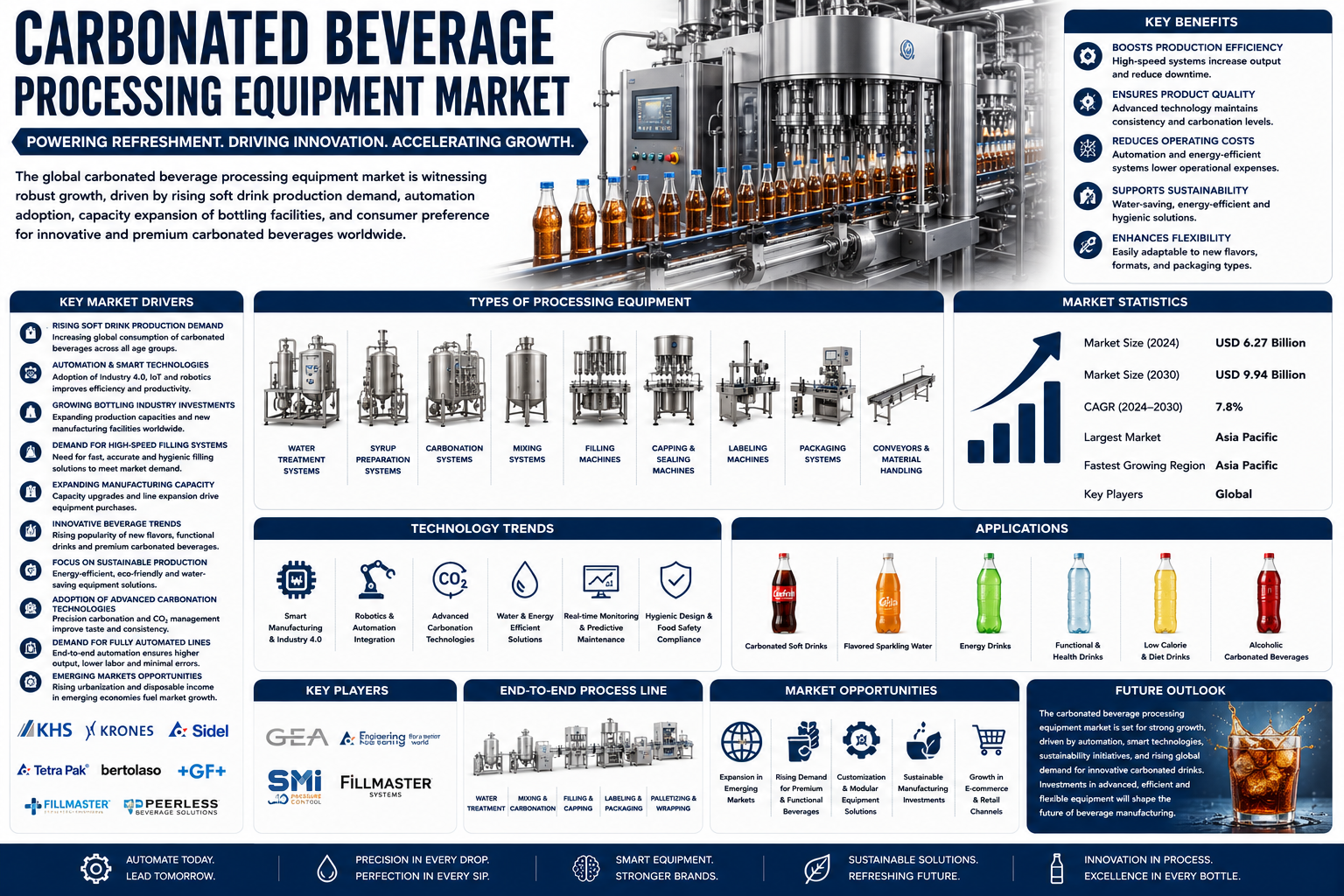
The global carbonated beverage processing equipment market is witnessing substantial growth as beverage manufacturers continue to expand production facilities to meet rising consumer demand. The growing popularity of carbonated soft drinks, flavored sparkling beverages, and innovative beverage products is encouraging companies to invest in advanced processing infrastructure. This trend is...
The eVTOL Aircraft Market is rapidly evolving as aviation innovators develop efficient transportation solutions for increasingly congested cities. Electric Vertical Take-Off and Landing (eVTOL) aircraft are gaining attention from transportation operators, technology companies, and government agencies seeking cleaner and faster mobility options. As per Market Research Future, growing investments...
The Glaucoma Therapeutics Market is characterised by intense competition among leading pharmaceutical and medical device companies, each striving to innovate and capture a larger share of the growing demand for effective treatments. Companies such as Allergan, Novartis, Bausch Health, and Glaukos Corporation are at the forefront, investing heavily in research and development. Recent strategic...