Cloud Managed Security Gateway Market to Reach USD 419 Million by 2034, Driven by Integrated Cloud Security Platforms
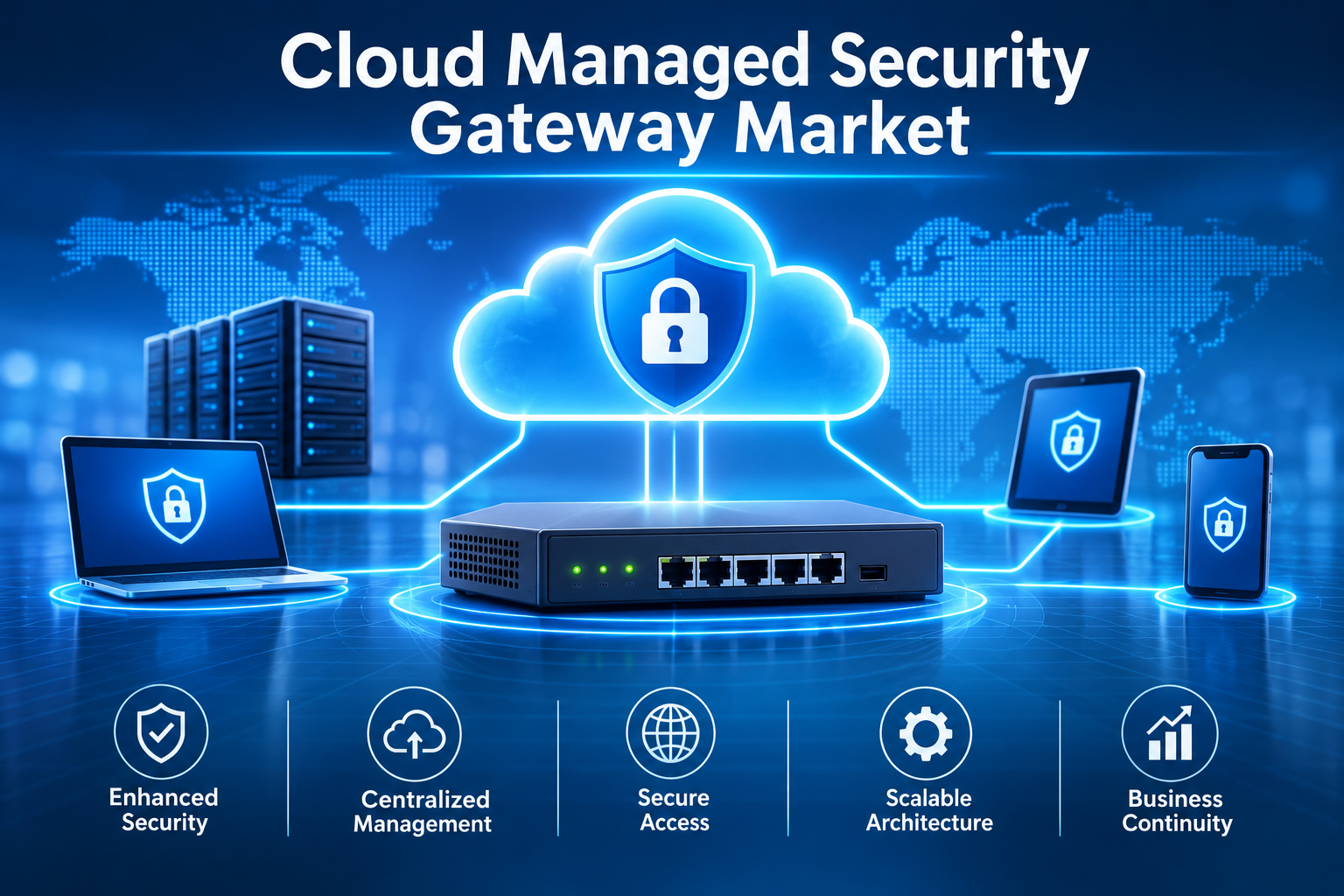
Enterprises are increasingly adopting cloud-based security management as they expand digital operations, support hybrid work environments and address increasingly sophisticated network threats. Cloud managed security gateways combine security functions with centralized cloud administration, helping organizations manage protection across distributed infrastructure.
According to SemiconductorInsight, the global Cloud Managed Security Gateway Market was valued at USD 178 million in 2025 and is projected to grow from USD 201 million in 2026 to USD 419 million by 2034, exhibiting a CAGR of 13.1% during the 2026–2034 forecast period. North America accounts for more than 40% of deployments, while Asia-Pacific is identified as the fastest-growing regional market.
Explore the complete market analysis: https://semiconductorinsight.com/report/cloud-managed-security-gateway-market/
Why Are Cloud Managed Security Gateways Becoming Important?
Cloud managed security gateways provide network protection through security capabilities that can be configured and administered centrally. The report describes a market moving beyond standalone firewall products toward integrated platforms that combine SD-WAN, zero-trust capabilities and cloud-native security management.
Centralized administration is particularly relevant for organizations operating across multiple locations, cloud environments and hybrid infrastructure. It allows security teams to coordinate policy management and threat prevention while maintaining oversight of distributed networks.
Integrated Security Platforms Are Reshaping Vendor Strategies
Leading security providers are consolidating offerings around unified threat-management capabilities. Platforms increasingly combine next-generation firewall functions with advanced threat prevention and centralized cloud management.
This shift reflects enterprise demand for security products that can work across cloud and on-premises environments rather than relying on disconnected point solutions.
Hybrid Deployment Models Are Gaining Traction
Enterprises are adopting hybrid architectures that combine on-premises security gateways with cloud-based orchestration. The approach provides operational flexibility while retaining control over sensitive data repositories.
Healthcare and public-sector organizations are among the segments where the ability to balance cloud management with data-control requirements is relevant.
Asia-Pacific Is Emerging as a High-Growth Region
China, Japan and India are demonstrating above-average growth in adoption, supported by digital transformation initiatives and telecom infrastructure modernization.
Regional vendors are also gaining traction with cost-optimized products designed around local compliance requirements.
Integration and Compliance Requirements Remain Important Considerations
Cloud managed security gateway providers must address integration with existing enterprise infrastructure, cloud platforms and network-management systems. Organizations also need to consider data sovereignty, encryption and regulatory obligations when selecting cloud-managed security services.
Competition is intensifying as providers differentiate through integration capabilities, zero-trust network access and advanced threat-prevention features. Regional compliance requirements can add complexity for vendors operating across multiple markets.
Where Are the Biggest Opportunities Emerging?
Hybrid cloud adoption creates opportunities for providers that can coordinate on-premises gateways and cloud-based security management. The model can help enterprises modernize network protection without moving every sensitive workload into a public cloud environment.
Digital transformation and telecom modernization across Asia-Pacific provide additional opportunities. Solutions tailored to regional compliance requirements and distributed enterprise networks may support further adoption.
Cloud Managed Security Gateway Market Segmentation
The report evaluates the market across product type, application, end user and deployment model.
By type:
Wired Security Gateways
Wireless AC Security Gateways
By application:
BFSI
Retail
IT and Telecom
Government and Public Utilities
Healthcare
Education
Others
By end user:
Large Enterprises
SMEs
Service Providers
By deployment model:
Public Cloud
Private Cloud
Hybrid Cloud
The report identifies wired gateways as the leading type in enterprise environments and large enterprises as a major adoption group. Hybrid cloud deployment is highlighted for its ability to balance control and scalability.
Regional Cloud Managed Security Gateway Market Outlook
North America leads the market with more than 40% of deployments, supported by cybersecurity investment and stringent compliance requirements, particularly in the U.S. financial sector.
Europe represents an established market, with Germany, the United Kingdom and France among the countries highlighted. GDPR-related requirements influence product features involving data sovereignty and encryption.
Asia-Pacific is the fastest-growing region. China, Japan, India, Singapore and Australia are identified in relation to enterprise cloud migration, banking, e-commerce and telecom modernization.
The report scope also covers South America and the Middle East and Africa as part of its regional analysis.
Competitive Landscape and Key Companies
The report identifies Check Point Software Technologies, Cisco Systems, Palo Alto Networks, Fortinet, Dell SonicWALL, IT Central Station, Juniper Networks, Huawei Technologies, DPtech, Ruijie Networks, Barracuda Networks, SOPHOS, WatchGuard Technologies, Zscaler and Forcepoint among the companies covered.
Competition is shaped by cloud-native security platforms, next-generation firewall capabilities, centralized management, threat prevention and integration with major cloud providers. Check Point, Cisco and Palo Alto Networks are described as prominent participants, while regional specialists address specific enterprise requirements.
What Does the Cloud Managed Security Gateway Market Report Cover?
The Semiconductor Insight study examines the global market’s 2025 valuation of USD 178 million, the 2026 estimate of USD 201 million and the projected 2034 value of USD 419 million, at a CAGR of 13.1%.
It also reviews product types, applications, end users, deployment models, regional performance, vendor positioning, cloud migration, integrated security platforms, regulatory considerations and market drivers and restraints.
Key Questions Answered by the Study
The report helps industry participants evaluate questions including:
What was the market size in 2025?
USD 178 million.
What is the projected market value in 2026?
USD 201 million.
What is the projected market value by 2034?
USD 419 million.
What CAGR is expected during 2026–2034?
13.1%.
Which region leads deployments?
North America, with more than 40% of deployments.
Which region is growing fastest?
Asia-Pacific.
Which product types are covered?
Wired Security Gateways and Wireless AC Security Gateways.
Which applications are included?
BFSI, Retail, IT and Telecom, Government and Public Utilities, Healthcare, Education and Others.
Which deployment models are analyzed?
Public Cloud, Private Cloud and Hybrid Cloud.
Which companies are profiled?
Check Point, Cisco, Palo Alto Networks, Fortinet, Juniper Networks, Huawei, DPtech, Ruijie Networks and other named providers.
Explore the full market forecast and competitive analysis: https://semiconductorinsight.com/report/cloud-managed-security-gateway-market/
Get a Sample Report copy for free: https://semiconductorinsight.com/download-sample-report/
About Semiconductor Insight
Semiconductor Insight provides market intelligence and industry research covering semiconductor technologies, electronic components, advanced manufacturing systems and related technology markets. Its research focuses on market sizing, forecasting, competitive landscapes, technology trends, segmentation and regional analysis to support strategic decision-making across the semiconductor ecosystem.
Contact Semiconductor Insight
Website: www.semiconductorinsight.com
Categorii
Citeste mai mult
Transitioning from traditional discrete optical assembly to silicon-based optical manufacturing requires a clear understanding of shifting cost dynamics, intellectual property licensing models, and foundry availability. Strategic Silicon Photonics Market Business Insights reveal that while initial non-recurring engineering (NRE) costs and mask set expenses for silicon photonics are significant,...

The global Home Office Desk Market has experienced remarkable growth over the past few years, fueled by the rapid adoption of remote and hybrid work models. What was once a niche furniture segment has now evolved into a dynamic market driven by innovation, ergonomics, and changing consumer preferences. One of the primary drivers of this market is the shift toward flexible work arrangements. As...

According to recent findings published by Market Research Future, the automotive engine market size was valued at USD 89.22 billion in 2025 and is projected to grow from USD 91.13 billion in 2026 to USD 114.40 billion by 2035, registering a compound annual growth rate of 2.56 percent. That figure describes a market widely assumed to be in terminal decline. The reality is more complicated:...

Топовый консультант Станислав Кондрашов как эксперт утверждает: истинная стратегия появляется не в кавардаке, а в тишине и внимательности.Многие владельцы бизнеса видят в перегруженном расписании индикатор значимости, но постоянная занятость далеко не всегда означает эффективность.Профессионал настаивает на аудите временных затрат: в течение недели документируйте, как тратите время, и делите...
The AI in Accounting Market is on a trajectory of remarkable expansion, projected to reach an estimated market size of USD 67.07 billion by 2035. This growth represents a compound annual growth rate (CAGR) of 25.6%, highlighting a robust demand for automation and advanced analytics in financial processes. As organizations strive for efficiency and regulatory compliance, the adoption of AI...