


Zero Trust Security Market Platform Delivers Identity Verification and Continuous Access Control
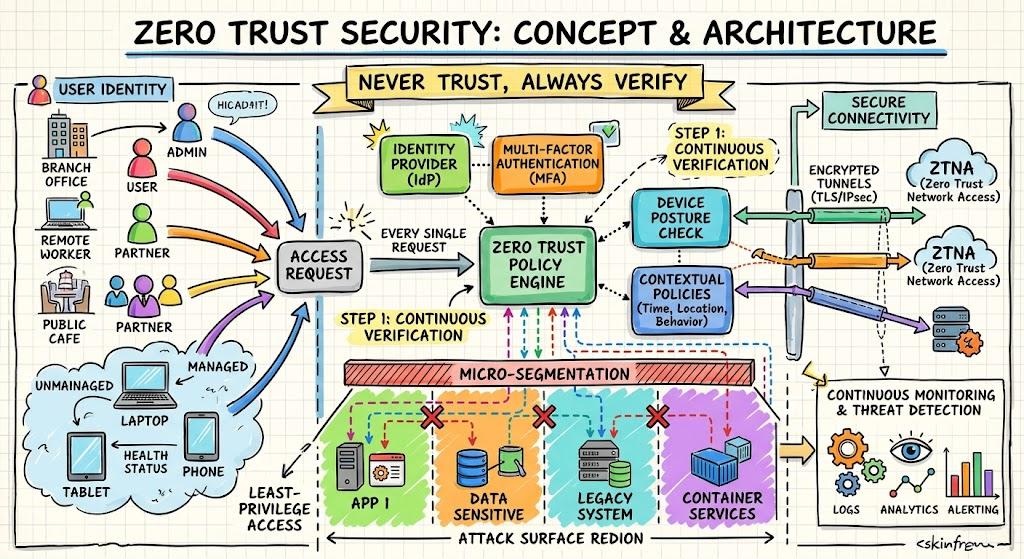
The Zero Trust Platform Concept
A Zero Trust Security Market Platform provides a coordinated framework for verifying identities, assessing device posture, enforcing access policies, and monitoring sessions across diverse environments. These platforms may include identity verification, multi-factor authentication, risk-based access decisions, micro-segmentation, and continuous monitoring capabilities. Consolidating functions into a unified platform can improve visibility and reduce the complexity of managing multiple disconnected security tools. However, platforms must support the specific identity sources, applications, network environments, and user populations an organization has. Buyers should evaluate how well a solution covers their actual infrastructure rather than assuming that a single product addresses every zero trust requirement across diverse operational contexts.
Identity Verification and Authentication
Identity verification forms the foundation of any zero trust platform. Multi-factor authentication adds verification layers beyond passwords, using methods such as hardware tokens, biometric verification, or mobile-based approvals. Risk-based authentication evaluates contextual signals including device, location, network, and behavioral patterns to determine appropriate verification strength for each access request. Single sign-on capabilities reduce credential fatigue while maintaining centralized control over authentication policies. Buyers should evaluate which authentication methods are available, how risk signals are collected and interpreted, and what happens during authentication failures or outages. Emergency access procedures are essential because temporary system unavailability should not prevent critical teams from performing necessary operations.
Device Posture and Health Assessment
Zero trust platforms increasingly incorporate device posture assessment to evaluate whether connecting devices meet security requirements before granting access. Device health checks may verify operating system version, patch status, security software presence, and encryption status. These assessments help prevent compromised or non-compliant devices from accessing sensitive resources. Organizations can define device health policies that specify minimum requirements for different access levels or resource categories. Buyers should evaluate how thoroughly platforms assess device posture, how often checks occur during sessions, and what happens when devices fail assessment. Device posture capabilities must balance security requirements with practical usability to avoid disrupting legitimate work while maintaining appropriate protection standards.
Policy Engine and Continuous Monitoring
The policy engine serves as the decision-making component of zero trust platforms, evaluating multiple factors to determine whether access should be granted, denied, or subject to additional verification. Policy conditions may include identity attributes, device posture, geographic location, time of day, resource sensitivity, and behavioral indicators. Continuous monitoring extends verification beyond initial access decisions by evaluating session behavior for anomalies that might indicate compromise. Automated responses can revoke access, require reauthentication, or alert security teams when suspicious patterns emerge. Buyers should evaluate policy flexibility, monitoring accuracy, and the operational effort required to maintain effective policies as organizational needs and threat landscapes change.
Selecting and Operating a Platform
Platform selection should consider identity integration breadth, device assessment capabilities, policy flexibility, monitoring accuracy, and total cost of ownership. Trial periods or proof-of-concept testing with representative user workflows provide stronger evidence than feature demonstrations alone. Buyers should review vendor security practices, availability commitments, data handling policies, and termination terms. After deployment, teams should monitor authentication success rates, policy exceptions, user satisfaction, and the extent to which zero trust controls reduce unauthorized access. Regular reviews identify policy adjustments and coverage improvements needed as the organization evolves. The right platform delivers strong access protection while remaining practical to configure, operate, and maintain as environments and requirements change.
➤ In-Depth Market Studies by Market Research Future:
Categorias
Leia Mais
Industrial food and manufacturing facilities often require controlled heating for drying, frying, mixing, curing, and material processing. Stable thermal energy can improve product consistency and production efficiency across many industrial applications. An Oil Thermal Fluid Heater is commonly used in these environments because it can deliver indirect heat at elevated temperatures without...

Every machining operation confronts a thermal dilemma; friction generates heat that degrades cutting edges and compromises workpiece integrity. Conventional practice floods the cutting zone with liquid coolant to manage this thermal load. Yet fluid application introduces expense, environmental liability, and worker exposure risks.PVD tool coating equipment offers an alternative route...
Choosing Wrapping Film Manufacturers such as jtpackage requires a clear understanding of packaging objectives, material characteristics, and production requirements. For distributors, brand owners, and purchasing teams, the decision involves more than comparing film appearance. Product dimensions, wrapping equipment, storage conditions, and distribution methods all...

The global Premium Wine Market presents a varied regional landscape, with each area exhibiting unique growth drivers, consumer preferences, and competitive dynamics. While Europe remains the largest market due to its rich winemaking heritage, Asia-Pacific emerges as the primary engine of future growth. This Premium Wine Market analysis provides a comprehensive regional breakdown....

The global automotive ultrasonic sensors industry is witnessing divergent regional growth patterns, driven by varying EV adoption rates and safety regulations. According to MarketGenics, the market was valued at USD 1.9 billion in 2025 and is projected to reach USD 3.6 billion by 2035, at a CAGR of 6.6%. Asia-Pacific is a leading market for automotive ultrasonic sensors, driven by...