


Global Beetroot Powder Market to Reach USD 1.0 Billion by 2036, Reveals FMI Study
Beetroot Powder Market to Reach USD 1.0 Billion by 2036
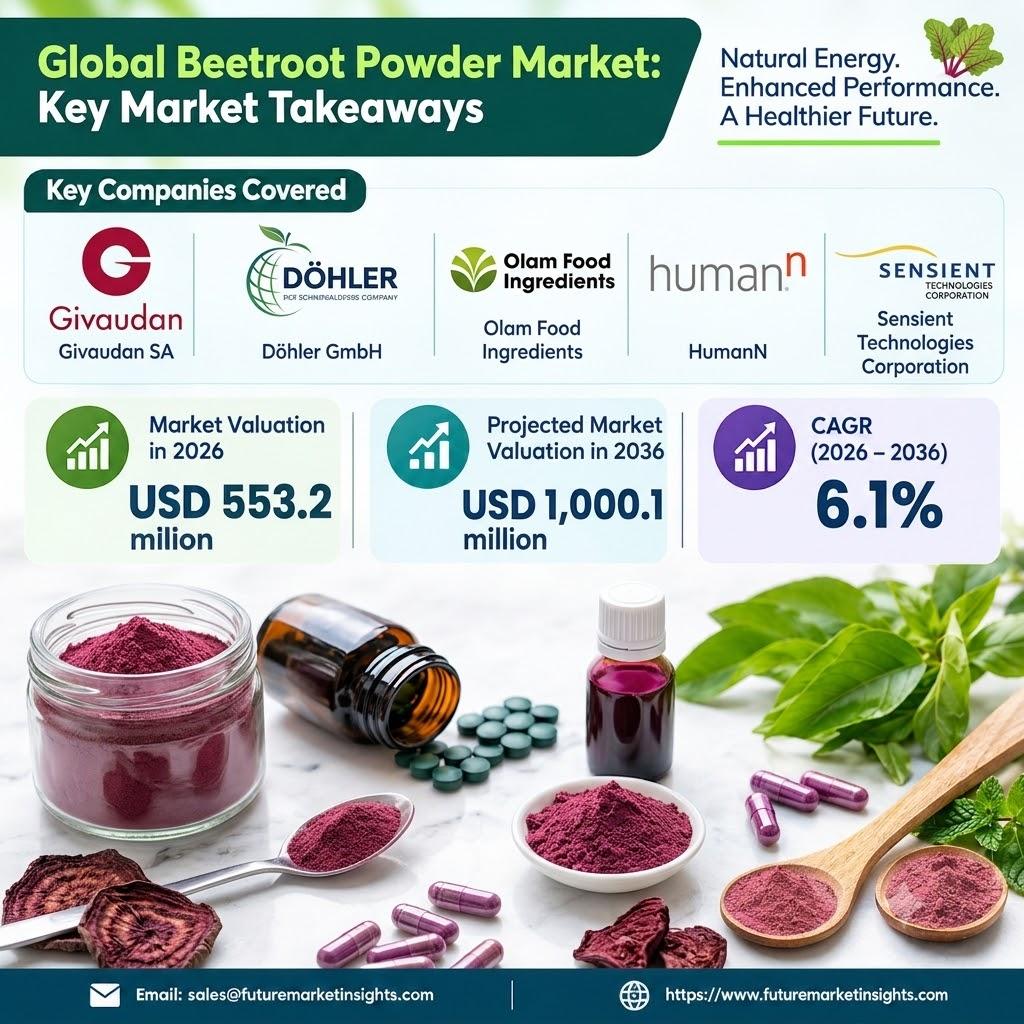
NEWARK, Del., October 23, 2026 — The global beetroot powder market is gaining momentum as food manufacturers, nutraceutical companies, and sports nutrition brands increase their focus on plant-derived ingredients for functional nutrition and natural food coloring. According to the latest market intelligence report published by Future Market Insights (FMI), the market was valued at USD 521.4 million in 2025 and is estimated to reach USD 553.2 million in 2026. The industry is projected to reach USD 1,000.1 million by 2036, expanding at a compound annual growth rate (CAGR) of 6.1% over the forecast period. Growth is supported by increasing demand for dietary supplements, interest in nitrate-standardized botanical ingredients, clean-label food formulations, and the adoption of beetroot powder as a natural source of red pigmentation in food and beverage products.
Beetroot Powder Market Key Market Takeaways
- Market Valuation: USD 553.2 million in 2026, projected to reach USD 1,000.1 million by 2036.
- Historical Market Value: USD 521.4 million in 2025.
- Growth Rate: Expanding at a CAGR of 6.1% from 2026 to 2036.
- Leading Drying Process: Spray-dried and drum-dried juice powder is projected to account for 57.7% of the drying process segment in 2026.
- Leading Nature Segment: Certified organic beetroot powder is expected to represent 60.3% of the nature segment in 2026.
- Leading Application: Dietary supplements are projected to account for 40.9% of the end-use application segment in 2026.
- Leading Nitrate Standardization: Products standardized above 2.0% dietary nitrate are expected to account for 62.9% of the nitrate standardization segment in 2026.
- Leading Sales Channel: B2B supplement and food ingredient supply is projected to represent 65.1% of the sales channel segment in 2026.
- Fastest-Growing Country: Australia is projected to record the highest growth among the profiled country markets, at a 7.1% CAGR.
- Other High-Growth Markets: Canada is forecast to grow at 6.8%, followed by the United States at 5.7%, the United Kingdom at 5.5%, and Germany at 5.4%.
- Core Growth Driver: Rising demand for functional nutrition, nitrate-standardized supplements, and plant-derived alternatives to synthetic food colorants.
Get Detailed Market Forecasts, Competitive Benchmarking & Industry Insights: Request a Sample Report: https://www.futuremarketinsights.com/reports/sample/rep-gb-3196
Industry Shifts & Market Dynamics
The beetroot powder market is evolving as manufacturers increasingly incorporate plant-based ingredients into dietary supplements, sports nutrition products, functional beverages, and clean-label food formulations. Beetroot powder is valued for its naturally occurring dietary nitrates, red betanin pigments, and versatility across powdered nutrition and food ingredient applications.
Dietary supplements represent an important source of demand. Beetroot powder is being incorporated into supplement blends, capsules, drink mixes, and other formulations intended for active consumers and wellness-oriented product lines. Dietary supplements are projected to account for 40.9% of the end-use application segment in 2026, highlighting their importance in the market's development.
Processing technology is another important market consideration. Spray-dried and drum-dried juice powders are projected to account for 57.7% of the drying process segment in 2026. These formats can support convenient blending and reconstitution in selected beverage and supplement applications. Manufacturers are also evaluating drying conditions and stabilization methods to maintain powder quality, solubility, and pigment characteristics.
Organic sourcing is becoming increasingly relevant as brands emphasize ingredient traceability and clean-label positioning. Certified organic beetroot powder is projected to represent 60.3% of the nature segment in 2026. For suppliers, maintaining certification, documenting sourcing practices, and implementing appropriate quality controls can help address buyer requirements.
Natural food coloring offers another avenue for market development. Beetroot powder contains betanin pigments that can provide red coloration in suitable food applications, including beverages, confectionery, dairy products, and plant-based foods. However, pigment stability can vary with temperature, pH, and processing conditions, requiring manufacturers to assess formulation suitability carefully.
Standardized dietary nitrate content is also an important differentiator. Products standardized above 2.0% dietary nitrate are expected to account for 62.9% of the nitrate standardization segment in 2026. Standardized ingredients can help supplement manufacturers maintain consistent specifications across batches, although testing, sourcing, and processing controls remain necessary.
Distribution strategies further influence the market. B2B supplement and food ingredient supply is projected to represent 65.1% of the sales channel segment in 2026. Bulk purchasing allows ingredient suppliers to serve supplement manufacturers, food processors, and contract formulation businesses that require consistent specifications and dependable supply.
Despite these opportunities, manufacturers must address raw material variability, drying costs, moisture control, nitrate consistency, pigment degradation, and competition from other botanical ingredients and natural colorants. Companies that combine reliable sourcing, suitable processing technology, consistent quality, and application-specific technical support may be better positioned to capture emerging opportunities.
Key Players Influencing the Beetroot Powder Market
HumanN, Givaudan SA, Döhler GmbH, Sensient Technologies Corporation, Olam Food Ingredients, Diana Food (Symrise AG), Kerry Group plc, and DSM-Firmenich AG are among the companies identified in the beetroot powder market landscape.
These companies participate in different parts of the ingredient value chain, including branded nutritional supplements, natural colors, botanical ingredients, and processed food ingredient supply.
Branded supplement businesses focus on consumer-facing products and formulations designed for wellness and active nutrition. Ingredient manufacturers and natural color specialists serve industrial customers seeking consistent pigment performance, botanical functionality, and formulation support.
Competitive positioning is influenced by sourcing capabilities, ingredient standardization, product quality, manufacturing technology, distribution networks, and the ability to meet the requirements of different food and supplement applications.
As demand for botanical ingredients expands, suppliers that can provide dependable specifications, traceable sourcing, and suitable formats for industrial processing may strengthen their competitive positions.
Recent Developments in the Beetroot Powder Market
- Natural Color Reformulation: Food manufacturers are evaluating plant-derived colorants as they respond to changing formulation requirements and initiatives to reduce reliance on certain synthetic dyes.
- Standardized Botanical Ingredients: Demand for documented nitrate content is encouraging suppliers to focus on ingredient testing, quality control, and consistent specifications.
- Processing Technology Improvements: Spray-drying, drum-drying, freeze-drying, and other dehydration methods offer different options for balancing processing efficiency, solubility, and ingredient quality.
- Organic Ingredient Sourcing: Traceability, certification, and pesticide-control requirements are influencing procurement decisions among clean-label food and supplement brands.
- Functional Nutrition Applications: Beetroot powder continues to offer opportunities in powdered supplements, functional beverages, and sports nutrition formulations.
- Ingredient Supplier Expansion: FMI's report identifies activity among major ingredient companies, including Givaudan, Kerry Group, and Olam Food Ingredients, across broader food, color, and botanical ingredient portfolios.
These developments represent broader market trends and selected company activities rather than announcements of specific beetroot powder product launches by every company listed.
For detailed Beetroot Powder Market analysis covering market size, forecasts, drying processes, organic and conventional products, end-use applications, nitrate standardization, sales channels, regional opportunities, and competitive developments, visit the official FMI report: https://www.futuremarketinsights.com/reports/beetroot-powder-market
Regional Market Summary
According to Future Market Insights, Australia is projected to record the fastest growth among the profiled country markets, with a CAGR of 7.1% from 2026 to 2036. Demand is supported by sports nutrition applications, interest in functional ingredients, and opportunities in clean-label food manufacturing.
Canada is forecast to expand at a CAGR of 6.8%, followed by the United States at 5.7%, the United Kingdom at 5.5%, and Germany at 5.4%. These markets offer opportunities across dietary supplements, natural food coloring, and botanical ingredient applications.
- Australia: The beetroot powder market is projected to grow at a CAGR of 7.1% from 2026 to 2036, supported by endurance-sport nutrition and demand for functional superfood ingredients.
- Canada: The market is forecast to expand at a CAGR of 6.8%, with opportunities across standardized botanical supplements, natural colorants, and food ingredient supply.
- United States: The market is projected to grow at a CAGR of 5.7%, supported by interest in nitrate-based supplements and the evaluation of plant-derived alternatives to synthetic food colors.
- United Kingdom: The market is expected to expand at a CAGR of 5.5%, with opportunities in wellness supplements, functional nutrition, and clean-label food applications.
- Germany: The market is forecast to grow at a CAGR of 5.4%, supported by food ingredient processing, natural color extraction, and sports nutrition applications.
Across these markets, product quality, regulatory compliance, consumer awareness, sourcing transparency, and the ability to preserve pigment and nitrate characteristics will influence adoption.
Analyst Insights
The beetroot powder market is being shaped by the convergence of functional nutrition, botanical supplements, and demand for plant-derived food ingredients. Manufacturers are evaluating beetroot powder for its suitability in supplement formulations and its potential to provide natural red coloration in selected food and beverage applications.
Spray-dried and drum-dried juice powders are projected to lead the drying process segment, highlighting the importance of solubility and processing convenience. Certified organic ingredients also hold a substantial position, reflecting the value that some manufacturers place on traceability and certification.
Dietary supplements remain a key application area, while standardized nitrate content provides another basis for ingredient differentiation. For B2B suppliers, consistent product specifications, reliable sourcing, and technical support are important when serving supplement brands and food processors.
Regional growth patterns point to opportunities in Australia and Canada, alongside established markets such as the United States, the United Kingdom, and Germany. However, manufacturers must balance product functionality with processing costs, ingredient stability, and applicable regulatory requirements.
Companies that invest in quality assurance, appropriate dehydration technology, standardized ingredient specifications, and application development may be better positioned to capture opportunities in the global beetroot powder market.
Frequently Asked Questions
Q: What is the projected size of the beetroot powder market by 2036?
A: The global beetroot powder market is projected to reach USD 1,000.1 million by 2036, increasing from USD 553.2 million in 2026.
Q: What was the value of the beetroot powder market in 2025?
A: The market was valued at USD 521.4 million in 2025, according to Future Market Insights.
Q: What is the expected growth rate of the beetroot powder market?
A: The market is forecast to grow at a CAGR of 6.1% between 2026 and 2036.
Q: Which drying process leads the beetroot powder market?
A: Spray-dried and drum-dried juice powder is projected to account for approximately 57.7% of the drying process segment in 2026.
Q: Which nature segment holds the leading share?
A: Certified organic beetroot powder is expected to represent approximately 60.3% of the nature segment in 2026.
Q: Which application leads the beetroot powder market?
A: Dietary supplements are projected to account for approximately 40.9% of the end-use application segment in 2026.
Q: Which nitrate standardization category holds the leading share?
A: Products standardized above 2.0% dietary nitrate are expected to account for approximately 62.9% of the nitrate standardization segment in 2026.
Q: Which sales channel leads the beetroot powder market?
A: B2B supplement and food ingredient supply is projected to represent approximately 65.1% of the sales channel segment in 2026.
Q: Which country is expected to record the fastest growth?
A: Australia is projected to record the highest growth among the profiled country markets, with a CAGR of 7.1% from 2026 to 2036.
Q: Who are the key players in the beetroot powder market?
A: Notable companies include HumanN, Givaudan SA, Döhler GmbH, Sensient Technologies Corporation, Olam Food Ingredients, Diana Food (Symrise AG), Kerry Group plc, and DSM-Firmenich AG.
Q: What factors are driving the beetroot powder market?
A: Key growth factors include demand for dietary supplements, interest in nitrate-standardized botanical ingredients, clean-label food formulations, organic sourcing, and plant-derived alternatives to synthetic food colorants.
Q: What challenges affect the beetroot powder market?
A: Important challenges include fluctuations in raw material composition, processing costs, nitrate standardization, pigment degradation under certain processing conditions, and competition from alternative botanical ingredients and natural colorants.
Q: How is beetroot powder used in food and beverage manufacturing?
A: Beetroot powder is used in dietary supplements, functional beverage mixes, superfood blends, and selected food applications where plant-derived red coloration and botanical ingredients are desirable.
Related Food & Beverage Industry Reports
Potato Flakes Market https://www.futuremarketinsights.com/reports/potato-flake-market
Protease Market https://www.futuremarketinsights.com/reports/protease-market
Pulses Market https://www.futuremarketinsights.com/reports/pulses-market
Demand for Massoia Bark Essential Oil in USA https://www.futuremarketinsights.com/reports/united-states-massoia-bark-essential-oil-market
Bakery Mixes Market https://www.futuremarketinsights.com/reports/bakery-mixes-market
About Future Market Insights
Future Market Insights (FMI) is an ESOMAR-certified market research and consulting firm providing syndicated, customized, investment, and social media research across industries, including food and beverage, healthcare, chemicals, technology, and consumer products. FMI delivers market intelligence, competitive analysis, and strategic insights to help organizations evaluate emerging opportunities and make informed business decisions. The company has offices in the United States, the United Kingdom, the UAE, and India.
Media Contact
For Press & Corporate Inquiries
Rahul Singh
AVP – Marketing and Growth Strategy
Future Market Insights, Inc.
Phone: +91 8600020075
For Sales: sales@futuremarketinsights.com
For Media: Rahul.singh@futuremarketinsights.com
Website: https://www.futuremarketinsights.com/
Kategorien
Mehr lesen
High Pressure Water Pump selection requires careful attention to application conditions, operating pressure, flow needs, and installation environment. Many buyers focus only on basic specifications, but a suitable solution depends on how the equipment will work in real situations. Industries such as manufacturing, cleaning, agriculture, and water treatment often need reliable pumping systems...
Heavy duty gearbox technology is built to withstand the most demanding industrial applications, including mining, steel production, and heavy material handling, where reliability and durability are non-negotiable. Analysis presented by Market Research Future indicates that the industrial gearbox market is projected to grow from USD 32.69 billion in 2025 to USD 51.25 billion by 2035. The...

Global PVA Brush for Semiconductor Market is gaining momentum as semiconductor manufacturers place greater emphasis on wafer cleanliness, contamination control, and high-yield manufacturing. The market was valued at US$41.7 million in 2024 and is projected to reach US$71.1 million by 2032, exhibiting a CAGR of 8.1% during the forecast period. PVA brushes are specialized cleaning tools made...

When it comes to creating smooth, high-quality paper, every step in the process counts. One compound that has gained attention among paper producers is Papermaking Polyacryalmide . By introducing this material, factories notice improvements in how fibers combine, how water moves, and how sheets take shape during production. Hengfeng provides products that allow operators to experiment with...

The global automated drug kiosk market is experiencing remarkable growth, driven by technological advancements, increasing consumer demand for convenience, and supportive regulatory frameworks. These self-service kiosks, which facilitate the dispensing of medications in a user-friendly manner, are becoming increasingly prevalent in pharmacies, hospitals, and public spaces. The market's...