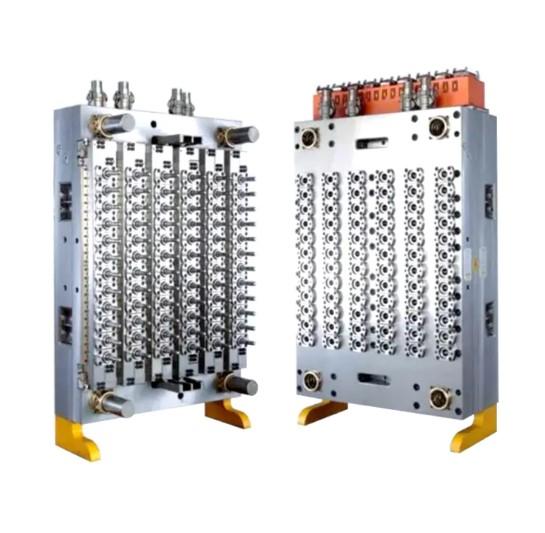
In plastic packaging production, selecting a reliable Handle Mold Manufacturer can influence the strength, appearance, dimensional accuracy, and manufacturing efficiency of bottle handles, while an experienced Handle Mold Manufacturer can help producers develop tooling around specific bottle sizes, grip structures, materials, and injection equipment. Bottle handles are commonly used on larger containers where convenient carrying is important, including household packaging, water containers, cleaning products, and other consumer packages. Because the handle must combine practical usability with consistent molding results, its tooling requires careful attention to cavity design, material flow, cooling, demolding, and maintenance.
Designing Handles Around Real Packaging Requirements
A bottle handle needs to do more than look attractive. It should provide a comfortable grip and remain sufficiently strong for the intended application. Its thickness, width, shape, connection points, and overall dimensions all affect the finished component.
A good design begins with the bottle itself. The handle must fit the container correctly and maintain the required position after molding or assembly. If the dimensions are inconsistent, the final package may look uneven or become difficult to assemble.
Different industries may require very different handle structures. A large household container may need a broad and reinforced grip, while a smaller package could benefit from a lighter and more compact configuration. Material usage should also be considered because unnecessary thickness can increase production costs without providing useful performance.
Before tooling begins, manufacturers should prepare clear product drawings or samples. Information about bottle dimensions, handle geometry, plastic material, expected output, and injection equipment can provide a useful foundation for development.
Qhpreformmould Tooling Approach for Bottle Handles
Tooling precision is important when a mould will be used repeatedly for high-volume production. The cavity must reproduce the intended geometry accurately, while cores, inserts, sliders, guide components, and other moving parts need to work together smoothly.
Complex handle shapes may include curved sections, narrow passages, reinforced areas, or connecting structures. These details require careful consideration during mould design because they can affect how molten plastic fills the cavity.
Gate and runner arrangements should support suitable material distribution. Poor filling balance may create visible defects, dimensional differences, or weak sections in the finished component.
Demolding also deserves attention. A finished handle needs to leave the cavity without excessive force or deformation. Depending on the design, suitable sliders, ejector systems, or other mechanisms may be required.
Precision machining is therefore connected to overall production performance. Accurate components can contribute to stable cycles, consistent parts, easier assembly, and more predictable maintenance.
Material Flow and Cooling Considerations
Plastic flow plays an important role in injection molding. The molten material needs to reach different sections of the cavity before solidifying. Handle designs with varying wall thicknesses may require additional attention to filling behavior.
Thicker areas can retain heat for longer than thinner sections. This makes cooling design important for achieving stable cycle times and consistent dimensions.
Cooling channels should be arranged according to the geometry of the tooling rather than added without considering the cavity structure. Balanced temperature control can help reduce variations between production cycles.
Material selection should also be discussed during development. Different plastics have different flow characteristics, shrinkage behavior, and processing conditions. The tooling should be compatible with the selected material and intended machine settings.
Production efficiency comes from balancing several factors at once. Faster cycles are useful only when the mould can continue producing parts that meet the required specifications. Cooling, injection conditions, material behavior, and machine capacity should therefore be evaluated together.
Customization for Different Bottle Applications
Packaging companies often develop unique bottle shapes to meet market requirements. A customized grip can make a container easier to carry while also giving the package a distinctive appearance.
Tooling can be developed around the exact product dimensions instead of forcing a specialized bottle to fit an unsuitable standard design. This approach provides more flexibility when the handle requires unusual proportions or connection structures.
Machine compatibility is another key consideration. The tooling dimensions, opening system, cooling connections, and operating requirements should correspond with the injection machine used for production.
Expected output also affects the design. A mould intended for continuous manufacturing may require stronger attention to component durability, maintenance access, cooling performance, and cycle efficiency.
Clear technical communication throughout the project can help reduce errors. Product drawings, material information, machine details, samples, and production targets should be reviewed before manufacturing starts.
Maintenance and Long-Term Manufacturing Value
Regular maintenance is essential for keeping tooling in suitable condition. Cleaning cavity surfaces can help prevent accumulated residue from affecting product appearance, while inspection of moving parts can identify wear before it causes production problems.
Sliders, guide components, ejector parts, seals, and other frequently operated elements may gradually experience wear. Having suitable replacement parts available can make servicing more convenient.
Cooling passages should also be checked periodically. Restrictions or deposits can reduce heat-transfer efficiency and influence cycle stability.
Maintenance access should ideally be considered during the initial design. Components that technicians can reach without excessive disassembly may help reduce downtime during servicing.
When evaluating a tooling partner, buyers should consider machining capability, customization experience, quality inspection, equipment compatibility, technical communication, maintenance support, and delivery arrangements.
A carefully developed mould can provide value throughout its service life by supporting consistent component dimensions, practical production cycles, reliable demolding, and manageable maintenance. Companies seeking customized bottle handle tooling solutions can learn more about Taizhou Qihong Mold Co., Ltd. .