Are Die Cast Aluminum Cookware Safe for Daily Cooking?
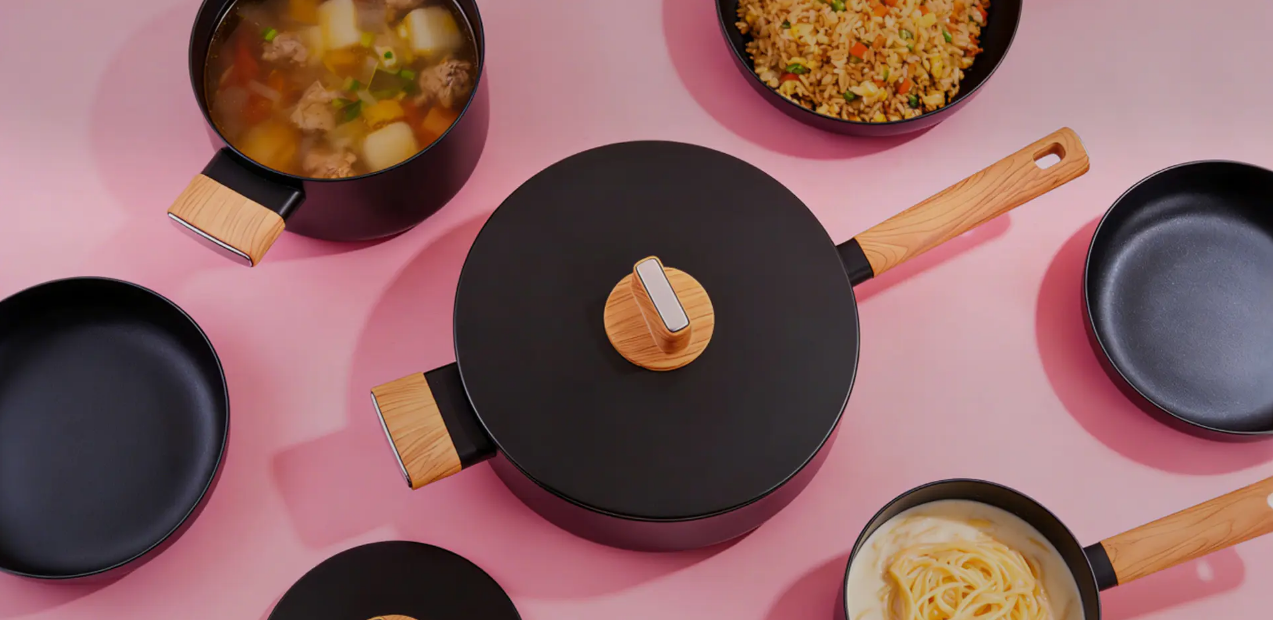
Safety is one of the most discussed topics when evaluating modern cookware materials. A die cast aluminum cookware set is widely used in households and commercial kitchens, and its safety depends on both the base material and the surface coating system.
The base aluminum used in die casting is typically food-grade alloy, formed under high pressure to create a dense structure. This manufacturing method reduces porosity and improves structural consistency. Aluminum itself is a good heat conductor, with thermal conductivity around 180–220 W/m·K, but pure aluminum is reactive with acidic foods. To address this, cookware manufacturers apply protective coatings or anodization layers.
Anodized aluminum creates a controlled oxide layer on the surface, typically between 20–50 microns thick in cookware applications. This layer acts as a barrier that reduces metal interaction with food. On top of this, most modern die cast aluminum cookware set products include non-stick coatings such as ceramic or PTFE-free sol-gel layers.
Ceramic coatings are commonly engineered to withstand temperatures up to approximately 250–300°C. They are free from PFAS-related compounds and provide a smooth cooking surface that reduces food adhesion. Multi-layer coatings may include primer layers, reinforced ceramic particles, and top protective finishes, improving scratch resistance.
From a safety perspective, coating integrity is critical. Once a coating is damaged or heavily scratched, exposure of raw aluminum can increase. However, under normal use conditions—low to medium heat cooking, non-abrasive utensils, and proper cleaning—the coating remains stable and safe for everyday cooking tasks.
Heat control is another important safety factor. Aluminum’s fast heat response can lead to overheating if not managed properly. Many modern cookware designs include heat-diffusing bases or encapsulated structures to distribute thermal energy more evenly. Base thickness often ranges between 4.0–5.5 mm, which helps prevent sudden temperature spikes.
Handle materials also contribute to safety performance. Heat-resistant bakelite or silicone handles are commonly used, typically rated for continuous exposure around 150–180°C. This ensures safe handling during cooking without heat transfer to the grip area.
In commercial safety discussions, regulatory standards such as FDA and LFGB compliance are often referenced. These certifications confirm that coatings and materials meet food-contact safety requirements under normal usage conditions.
Another consideration is cookware lifespan. Ceramic coatings gradually wear over time due to mechanical abrasion and repeated thermal cycling. A typical service life may range from 1 to 3 years depending on usage intensity. Proper maintenance, such as avoiding metal utensils and high-heat empty preheating, extends usability.
Overall, a die cast aluminum cookware set is considered safe for everyday cooking when used within recommended temperature limits and maintained properly. The combination of stable aluminum structure and modern coating technology creates a controlled cooking environment suitable for diverse food preparation needs.
Categorias
Leia Mais
When developing vehicle-oriented drinkware, selecting an Auto Mug Factory means looking beyond the finished cup and examining how the factory manages materials, production, customization, quality, and product development. Yongkang Xiaoyu Industry & Trade Co., Ltd. specializes in plastic cups, thermos cups, travel mugs, and insulated drinkware, with services covering design,...
Scoring was significantly further more common upon Wednesday, yet the Dodgers shielded their 3rd directly onerun gain in opposition to the Tampa Bay Rays, using the finale 54 towards extensive the which include upon Tuesday Tyler Glasnow Jersey, either groups had been saved scoreless more than the initial 3 innings, as Shohei Ohtani and Shane McClanahan permitted simply 2 baserunners apiece...

In plastic packaging production, selecting a reliable Handle Mold Manufacturer can influence the strength, appearance, dimensional accuracy, and manufacturing efficiency of bottle handles, while an experienced Handle Mold Manufacturer can help producers develop tooling around specific bottle sizes, grip structures, materials, and injection equipment. Bottle handles are commonly used on...

Global AI Chiplet Integration Platform Market is witnessing a wave of strategic investments and technology breakthroughs that are reshaping the semiconductor landscape. Driven by the relentless demand for higher compute density, lower power consumption, and faster time‑to‑market, the market is rapidly evolving into a cornerstone of next‑generation AI hardware ecosystems. AI chiplet...

The evolution of indoor cultivation strategies represents a crucial pivot point in rural-urban food distribution, establishing stable supply channels for perishable produce across tier-one and tier-two cities. Integrating advanced Internet of Things monitoring arrays, artificial intelligence analytics, and precise nutrient dosing mechanisms enables commercial growers to manage microclimates,...