


Material Engineering Behind Bumper Mold Performance
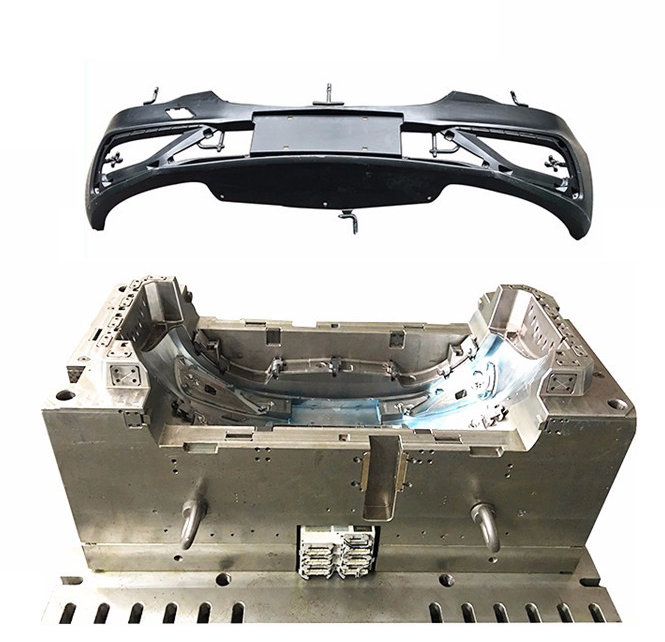
The durability and performance of a Bumper Mold are highly dependent on the choice of mold material. Since bumper molds operate under high injection pressure and repeated thermal cycles, material selection directly affects lifespan and product quality.
Commonly used steels include P20, 718H, and H13. P20 is widely used for medium-volume production due to its good machinability and moderate hardness of around 28–32 HRC. It is suitable for molds requiring up to 300,000 cycles.
For higher durability, 718H steel is often selected. It offers improved polishability and hardness levels around 33–36 HRC, making it suitable for high-quality automotive exterior surfaces.
H13 steel is used in high-stress areas of bumper molds due to its excellent thermal resistance. It can withstand working temperatures above 600°C during heat treatment processes and offers hardness up to 48–52 HRC.
Surface treatment methods such as nitriding or chrome plating further enhance mold life by increasing surface hardness and corrosion resistance. Nitrided layers typically reach depths of 0.3–0.5 mm.
Cooling efficiency also plays a role in material performance. Proper thermal conductivity ensures uniform temperature distribution, reducing stress concentration within the mold structure.
A well-designed Bumper Mold using high-grade steel can achieve service lives exceeding 500,000 injection cycles under stable production conditions.
In summary, material selection is not just a cost decision but a long-term performance strategy that directly impacts production stability and product consistency.
Κατηγορίες
Διαβάζω περισσότερα
Възходът на виртуалната реалност в онлайн казината: Как VR технологията променя хазартния опит през 2025 г. През последните години технологичният напредък в сферата на виртуалната реалност (VR) е поставил нови стандарти в различни индустрии, а хазартният сектор не е изключение. С развитието на онлайн казината, които вече предлагат богат избор от игри и опции https://hitnspin.casino/bg/bonuses/...

The Normal Temperature Superconductor Technology market research report has been crafted with the most advanced and best tools to collect, record, estimate, and analyze market data. The report also sheds light on the market overview in its entirety touching diverse aspects like product definition, prevailing vendor landscape, and market segmentation. Through the comprehensive and systematic...

The Europe Leather Luggage and Goods Market is experiencing steady growth as rising consumer spending on luxury goods, increasing travel activity, and strong cultural appreciation for premium craftsmanship drive demand for quality leather luggage and accessories. This comprehensive Europe Leather Luggage and Goods Market analysis explores the evolving landscape of leather suitcases,...

Veneer Door selection should begin with the requirements of the project, not only the visual effect. Buyers should examine the wood species, grain pattern, core construction, dimensions, thickness, surface finish, edge treatment, hardware preparation, installation conditions, and intended room. For larger projects, sample approval, color consistency, customized details, packaging, and...

The global Persulfates Market is gaining opportunities from the continued expansion of electronics and semiconductor manufacturing. Persulfates are used as etching and oxidizing agents in printed circuit board production and semiconductor-related processes, making them valuable materials for advanced electronics manufacturing. The electronics industry is becoming increasingly dependent on...