


BaoZhiWei on Custom Lighting for Various Vehicle Models
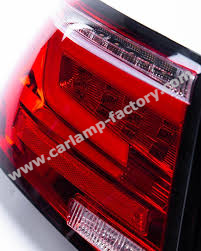
The surprising part is that the rolling sweep across the lens is not produced by the car at all. The vehicle sends an ordinary on-off signal, and a small controller on the assembly's own circuit board turns it into a timed chase, which is why a set of Sequential Led Tail Lights can look so elaborate while the wiring behind it stays simple.
Behind the lens sits a row of small LED groups, each wired so it can be switched separately. When the indicator signal arrives, the controller lights the first group, then the next, and so on along the row until it is full, after which everything goes dark and the cycle restarts in step with the car's flasher. Each step lasts a fraction of a second, so the eye blends the steps into one moving arrow.
On a bench I connected a battery with a jumper wire in a shaded corner of a garage. Fed steadily, the sweep ran smoothly, but when I touched the wire to the terminal in slow taps, the individual steps appeared one at a time, like frames of a film strip. That showed me the motion is a series of separate switches and not a single fading glow.
Timing is something you can judge with a phone camera. Filming the lamp in slow motion in a dim room shows whether the steps are evenly spaced or whether one group lingers a beat too long, and uneven spacing reads as a stutter to the driver behind. A smooth rhythm depends on the controller holding each step for the same short span, and a cheap board that drifts shows up right away on the screen.
The same board usually handles the other duties of a rear assembly. A running glow burns at low output, the brake function jumps to full brightness when the pedal goes down, and the reversing section stays dark until the gearbox sends current. In designs of this kind the controller also decides what happens when two signals arrive together, so one side can sweep for a turn while the other side holds its brake glow.
On the bench beside the battery was a sample from BaoZhiWei, the brand of Taizhou Baozhiwei Vehicle Industry Co., Ltd., a manufacturer of automotive lighting based in Taizhou, China, that makes LED tail lights, headlights, and custom lighting solutions for various vehicle models. The company describes integrated design and production capabilities, which speaks of process and not of any measurement on this sample, and no specification sheet came with it, so I am reporting only what I could see.
Flasher compatibility is the usual snag. A car expects a certain electrical load from filament bulbs, and diodes draw far less, so the flasher unit may read a fault and blink too quickly, a habit known as hyper flash. A load resistor or a flasher built for diodes cures it, and the quick tick of the relay under the dashboard gives the problem away before anyone opens a toolbox.
Wiring is the part that surprises people who expect a complicated install. A handful of leads carries the running, brake, turn and reversing signals, and the plug on the back has to match the car's socket in shape and pin layout. I hold the new plug beside the old one before touching anything, and I check each lead for a clean crimp, since a loose connection can cost an afternoon of guessing.
The lens and housing do their share of the work too. A clear or tinted plastic cover passes the glow, molded patterns inside it blend the separate groups so the sweep looks even from an angle, and a bead of adhesive or a gasket along the seam keeps moisture off the circuit. Polarity matters as well, since diodes pass current in one direction, and a reversed wire can leave a section dark even though the plug seems fine.
Warmth is a quiet factor. The diodes and their driver chips give off heat during long use, and the shell has to let it spread out while keeping rain from getting in. A lamp left lit on the bench for an hour tells you plenty if you rest a palm on the back, because gentle warmth is ordinary while a sharp, localized hot spot points to a crowded board.
Photographs on the page at https://www.carlamp-factory.com/product/ show lens shapes and colors, but the sweep itself only appears once power is applied. Next time you stand behind a set of Sequential Led Tail Lights with the indicator running, watch the segment nearest the center, because the time it stays lit before its neighbor joins in shows how the controller is paced.
Kategorien
Mehr lesen
Building a strong online presence takes more than simply creating a website or posting on social media. Businesses need to reach the right audience, attract qualified visitors, build trust, and turn online attention into real customers. This is where a Digital Marketing Agency can make a meaningful difference. A professional agency brings different marketing services together under...

Aluminum Die Casting Machine Market Size: Global Valuation, Growth Drivers, and Forecast Market Size and Growth Outlook The Aluminum Die Casting Machine Market Size reflects growing investment in precision manufacturing and the production of lightweight metal components. These machines are used to create complex aluminum parts for automotive, aerospace, industrial, construction, and...

Examining the slingshot market, covering global market dynamics, regional insights including North America and Asia-Pacific, and the future outlook for slingshots through 2035. The Slingshot Market represents the comprehensive landscape of global outdoor recreational innovations, providing essential technologies that enable accurate, reliable, and enjoyable projectile launching for sport,...
The Leafy Vegetable Growth Liquid Market is a specialized and rapidly growing segment within the broader plant nutrition industry. These liquid formulations are specifically designed to meet the unique nutritional needs of fast-growing leafy greens like lettuce, spinach, and kale, which are staples of hydroponic and indoor farming. As the demand for fresh, local, and sustainable leafy greens...

Asia-Pacific is becoming an increasingly important region for the global foodservice equipment industry as urbanization, rising disposable incomes, and changing consumer preferences encourage restaurant expansion. These trends are creating significant opportunities within the Restaurant Equipment Market. The global market is projected to rise from USD 99.87 billion in 2025 to USD 206.07 billion...